

Aviation VOO SCE: The Cooperative Amid the VOO Insolvency Proceedings
While the insolvency proceedings for VOO Aviation Service GmbH and VOO flights GmbH are underway in Austria, a previously overlooked construct is increasingly moving into focus: Aviation VOO SCE, a European Cooperative (SCE) based in Graz. It is legally distinct from the insolvent limited liability companies (GmbHs) – and this very separation is the key to understanding current developments.
A New Entity – Legally Clean, Factually Intertwined
The statutes of Aviation VOO SCE explicitly do not concern the insolvent GmbHs, but rather an independent cooperative. For creditors of the VOO GmbHs, this means that claims against the insolvent entities cannot be automatically transferred to the SCE – and vice versa. This structure is central to the “restart narratives” we have documented: while operating companies fail, a new legal entity emerges in parallel. Communicatively, it links back to previous projects, yet legally, it starts with a clean slate.
Membership Funds as a Liquidity Buffer?
The most striking detail in the official commercial register: Aviation VOO SCE was registered on July 19, 2024, with a share capital of only 100 euros, located at Liebenauer Hauptstraße 320 in Graz. In traditional cooperative or startup contexts, such a low capital stock alone would indicate that the legal shell serves primarily as a formality rather than representing economic substance. According to the register, Gernot Winter is currently listed as the sole board member; his associate, Roman Philipp, was removed as a board member only days after the registration.

Particularly noteworthy are the statutory regulations regarding member credits. While there is a general entitlement to the payout of shares upon resignation, payouts only occur two years after the end of the fiscal year – and they can be entirely refused if the board determines that the cooperative’s liquidity does not permit it.
In practice, this construction acts as a contractual lock-up at the expense of the members. Especially near a crisis or insolvency, repayments can be blocked indefinitely – a logic familiar from token- or platform-based systems like Homnifi, where users provide funding without having any control or exit rights.
30,000 Euro Minimum Capital – 100 Euro in the Register?
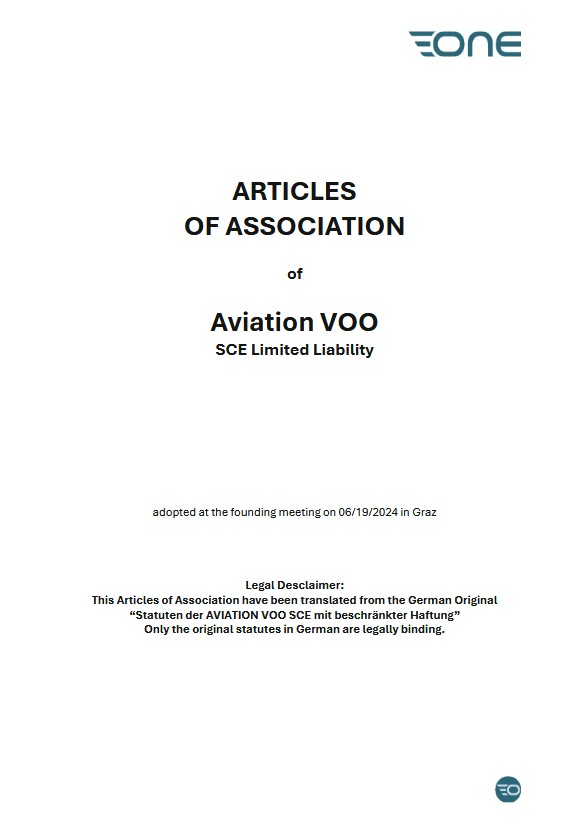
A further contradiction arises from the interplay between the statutes and the commercial register: the statutes cite a minimum capital of 30,000 euros, while the public register for Aviation VOO SCE shows a share capital of only 100 euros. Formally, this can be explained by the “variable capital” system inherent to cooperatives. However, the question remains: what capital was actually raised – and how valuable are membership shares during a phase in which affiliated companies are insolvent?
In the classic cooperative landscape, shares are considered genuine capital contributions used to fund projects, infrastructure, or technology. A total share capital of just 100 euros suggests that this vehicle possesses almost no real economic substance. This capital is extremely low for an entity that intends to support large-scale digital projects (mobility, aviation) in its statutes – and stands in sharp contrast to the communicated vision of complex ecosystems surrounding VOO, AVINOC, and NOMO.
Furthermore, the statutes of Aviation VOO SCE reveal a remarkable imbalance between the duties of members and their actual rights. While the outward image is that of a community-supported organization, the legal framework suggests that economic risks are shifted almost entirely onto the members.
Member Recruitment as a Statutory Success Factor
A new and particularly delicate element is the role of member recruitment, which is firmly anchored in the statutes. The categories “User A” and “User B” explicitly provide for financial contributions, active usage, assistance in recruiting new members, and the “dissemination of the idea.” The board can define further categories at any time.
Combined with a lack of interest on shares, unclear economic consideration (“added value in whatever form”), and the ability to address non-members, an incentive system is created that – depending on public presentation and sales – can favor pyramid-like dynamics. This is not automatically illegal, but it is precisely the gray area we have long criticized within the Safir/ZENIQ/XERA/XPRO/VOO/Vision.One environment.
The Personnel Constant: Gernot Winter
The continuity of personnel is particularly explosive: the only board member registered for Aviation VOO SCE is Gernot Winter – the same actor who played a central economic and communicative role in the failed and now insolvent projects AVINOC and VOO. This means: while the cooperative structure is formally democratic (“one member, one vote”), it is de facto extremely centralized, as Gernot Winter serves as the sole registered leader. The statutes allow the board to set entrance fees, membership dues, or premiums at its own discretion, without the need for transparency or oversight. Given the lofty promises – such as aviation IT solutions or digital ecosystems – this remains difficult to explain.

Winter was not only a driving force behind VOO and AVINOC but also stepped into the spotlight with these projects during crypto-marketing events like Safir/ZENIQ. In a recent video call, Winter attempted to “answer to” former Safir/ZENIQ investors. Essential questions remained unanswered in this call, including: Where did the collected money go? What responsibility do the organizers bear?
Instead, the call was dominated by rhetorically inflated explanations devoid of substantive facts. Winter’s reasoning followed a pattern of systematically shifting responsibility: onto “independent product owners,” network partners, or the market – and away from central liability.
This recurring strategy – grand visions and wide-reaching narratives, but almost no concrete traceability – continues in the current VOO/Vision.One narrative: despite insolvencies, legal uncertainties, and a lack of results, central figures remain present and occupy communicative positions without providing clear answers.
Conclusion: Unresolved Questions of Significant Scope
Against the backdrop of the insolvencies, central questions regarding Aviation VOO SCE arise:
Were there transfers of IP, trademarks, domains, or software between the GmbHs and the SCE?
Do licensing or service agreements exist between the insolvent units and the cooperative?
How many members are there, how many shares have been issued, and how much capital has been paid in?
How many resignations and blocked payout claims already exist?
The statutes of Aviation VOO SCE are clearly “cooperative-friendly” rather than “member-friendly” in crisis situations. Long payout periods, liquidity reservations, centralized control, and the explicit role of member recruitment make claims difficult to enforce—even without a formal insolvency of the cooperative itself. In the context of the failed VOO GmbHs, the impression is reinforced that risks are systematically outsourced while new structures are intended to secure trust and funding. Not all of this is illegal. However, much of it requires explanation—and that is exactly why it is of public interest.
Note:
This article is a journalistic analysis. It is based on publicly available sources. It is not a legal assessment or financial advice. All assessments have been researched to the best of our knowledge and are marked as opinions within the meaning of Art. 10 ECHR / Art. 5 GG. Counterstatements will be taken into account in accordance with § 56 RStV.
Sources:
- Aviation VOO SCE: https://v1co.org/
- Die Elektronische Verlautbarungs- und Informationsplattform des Bundes: https://www.evi.gv.at/f/631506k
- Business Data Gernot Winter: https://www.northdata.de/Winter,%20Gernot%20W%C2%B7,%20Graz/sy1
- Ewn Verification (Editorial Team): data, domain/company check





Leave a Reply
Want to join the discussion?Feel free to contribute!