
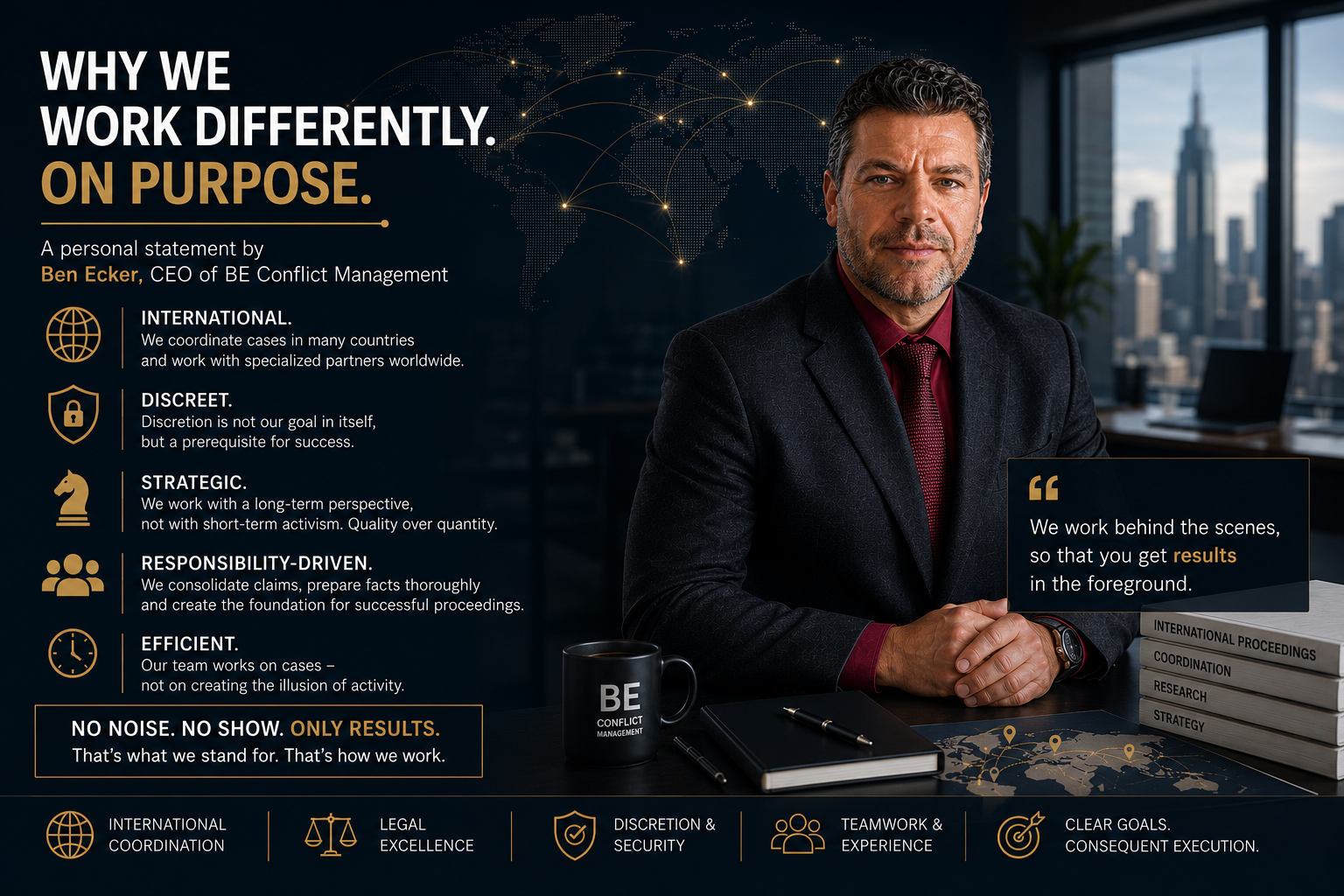
BECM Insights – Why We Choose a Different Approach
A personal statement from Ben Ecker, CEO of BE Conflict Management
As CEO of BE Conflict Management, I am often asked why we operate differently from a traditional law firm or a conventional collection agency. The answer is straightforward: our work, our responsibilities, and the international environment in which we operate are fundamentally different from a standard one-on-one legal engagement.
This statement sets out the principles that have guided BE Conflict Management from the beginning. It is intended for current and prospective clients alike, and it reflects what we consider to be the foundation of a professional, respectful, and productive working relationship.
Before anything else, I want to make one point clear. The overwhelming majority of our more than 3,000 active clients deal with us patiently, respectfully, and in good faith. We value that trust. This statement is not directed at them. The people it does concern will recognize themselves.
BE Conflict Management is not a law firm. We are not a traditional debt collection agency. We do not sell financial products, and we do not operate a recovery program. We are also not a hotline whose purpose is to create a sense of constant activity through endless messages, phone calls, or status updates.
Yet that is exactly what some people appear to expect.
We receive demands for weekly reports, personal calls, immediate responses, and individual explanations of every development. Some clients seem to assume that thousands of people can be served as though each had retained a law firm for a separate, fully customized legal matter. That is not our model, and it has never been represented as such.

With this statement, I would like to explain why we deliberately work differently and why this specific approach forms the foundation of our international activities. I cordially invite you to form your own impression.”
A lawyer can, of course, provide frequent calls, detailed reports, and individualized advice on every step. That work is billed accordingly. Emails, phone calls, meetings, letters, and legal analysis all take time, and that time is charged. There is nothing improper about that; it is simply a different service model.
Our fee structure is designed to make international claims coordination economically accessible to a broad group of affected parties. The fees are generally far lower than the cost of retaining a specialized law firm for an individual cross-border matter. What cannot reasonably be expected is the price structure of a coordinated group model combined with the level of personal attention associated with a high-cost individual legal engagement. Those two expectations do not fit together.
There is another important difference that is too often overlooked: the matters we work on do not stop at a national border.
The MLM and investment-related matters we coordinate frequently involve multiple countries, different legal systems, regulatory authorities, insolvency proceedings, criminal investigations, and cross-border asset and corporate structures. A single lawyer is generally limited by the jurisdictions in which he or she is admitted to practice. International coordination is therefore not optional in this field; it is essential.
Through our partners within the BE-EEIG (European Economic Interest Grouping), we coordinate the organizational aspects of international claims, consolidate similar matters from multiple jurisdictions, prepare and structure information, and facilitate cooperation with external specialists and partner law firms. Where legal or tax advice is required, it is provided exclusively by appropriately licensed attorneys, tax advisers, or other authorized professionals. BE Conflict Management itself does not provide legal or tax advice.
That is why our model exists.
Our team is employed to move matters forward, organize information, coordinate professionals, and support the operational work required in complex international cases. They are not employed to manufacture activity or to produce reports with no substantive value. Nor should they spend their time answering hundreds of emails or social media messages that would ultimately say nothing more than: ‘There are no material developments to report at this time.’
If there is nothing new to report, then there is nothing new to report. We will not publish artificial updates simply to create the impression that something is happening.
Many people coming from the MLM world are used to constant announcements, motivational calls, presentations, success stories, and a steady stream of supposed ‘news.’ In that environment, activity is often confused with progress. We will not adopt that approach.
There is also a security and confidentiality issue that some people underestimate. Our work does not take place in a vacuum. Opposing parties monitor public statements. Publications are analyzed. Third parties attempt to obtain information. Fake clients may be introduced, and existing clients may be contacted in an effort to learn what we are doing or how a particular matter is progressing.
Under those circumstances, anyone who expects us to publicly discuss every interim step or disclose our strategic considerations has not understood the sensitivity of this work. Discretion is not secrecy for its own sake. In many cases, it is a basic requirement for effective action.
There is one more issue that needs to be addressed directly: the manner in which some people choose to communicate with us.
We increasingly receive vague or casual social media messages from individuals who do not identify themselves properly and provide no meaningful context. Messages such as ‘Hey, what’s up?’, ‘Any news?’, or ‘Come on, make an announcement’ are not an acceptable basis for professional communication.
Would you write to your attorney, accountant, notary, or business partner that way? We doubt it.
We will not respond to messages of that kind. Anyone contacting us is entitled to be treated seriously and respectfully. In return, we expect basic professionalism, courtesy, clear identification, and a properly stated request.
This is also reflected in our contractual framework. Section 10.7 of our General Terms and Conditions expressly provides that general inquiries, ongoing status reports, and individualized support beyond the agreed scope of services are not part of the agreement. Our clients are entitled to expect that we will perform the services we agreed to provide, professionally and responsibly. We are equally entitled to expect that the agreement will be respected by both sides.
Respect is not a one-way obligation.
We do not owe anyone daily running commentary. We do not owe anyone artificial success stories. We do not owe anyone communication designed merely to keep them occupied.
What we do owe our clients is professionalism, integrity, and the responsible use of the resources entrusted to our work. That means investing our time where it produces the greatest value: in the actual coordination and advancement of their matters, not in communication for its own sake.
Those who understand our model will understand why we have deliberately chosen a different approach. Those who expect thousands of people to receive the same level of attention that a law firm might provide to a small number of individually billed clients will probably never be satisfied with our model. That is acceptable. Not every service model is right for every person.
What will not happen is that we redesign our operations around unrealistic expectations.
We have never presented ourselves as a recovery program, and we have never offered one. From the outset, our model has been based on structured assignment of claims and international coordination. Anyone who confuses those concepts is evaluating our work by the wrong standard.
Transparency and accountability have been part of BE Conflict Management’s operating philosophy since its founding. We have never hidden what we do, how we work, or where the limits of our services lie.
On April 20, 2022, we published our Q&A, ‘BE Conflict Management with Ben Ecker, CEO,’ explaining who we are, how we work, and – equally important – what we are not. We explained why we are not a traditional law firm, why international coordination is essential, why communication must be structured, and why we do not offer guarantees or make unrealistic promises.
Those principles remain unchanged.
This statement is not a new justification of our work. It is a clear restatement of the standards by which we have operated for years. In a complex and sensitive international field, we believe that clarity matters. We also believe our work should be judged by the model we actually offer – not by expectations borrowed from a traditional law firm or a so-called recovery program, neither of which we have ever claimed to be.
Anyone who wants a fuller understanding of our approach is invited to read our 2022 Q&A. We encourage every current and prospective client to review our model carefully, understand the scope of the service, and decide whether it is the right fit for them.
Further Reading
This statement is consistent with the principles we have communicated publicly for many years.
Readers who would like to learn more about the origins of our business model, our philosophy and the scope of our services are invited to read our CEO Q&A, originally published on 20 April 2022:
Q&A – BE Conflict Managementwith Ben Ecker, CEO – BE CONFLICT MANAGEMENT
Ben Ecker
CEO – BE Conflict Management

Leave a Reply
Want to join the discussion?Feel free to contribute!