
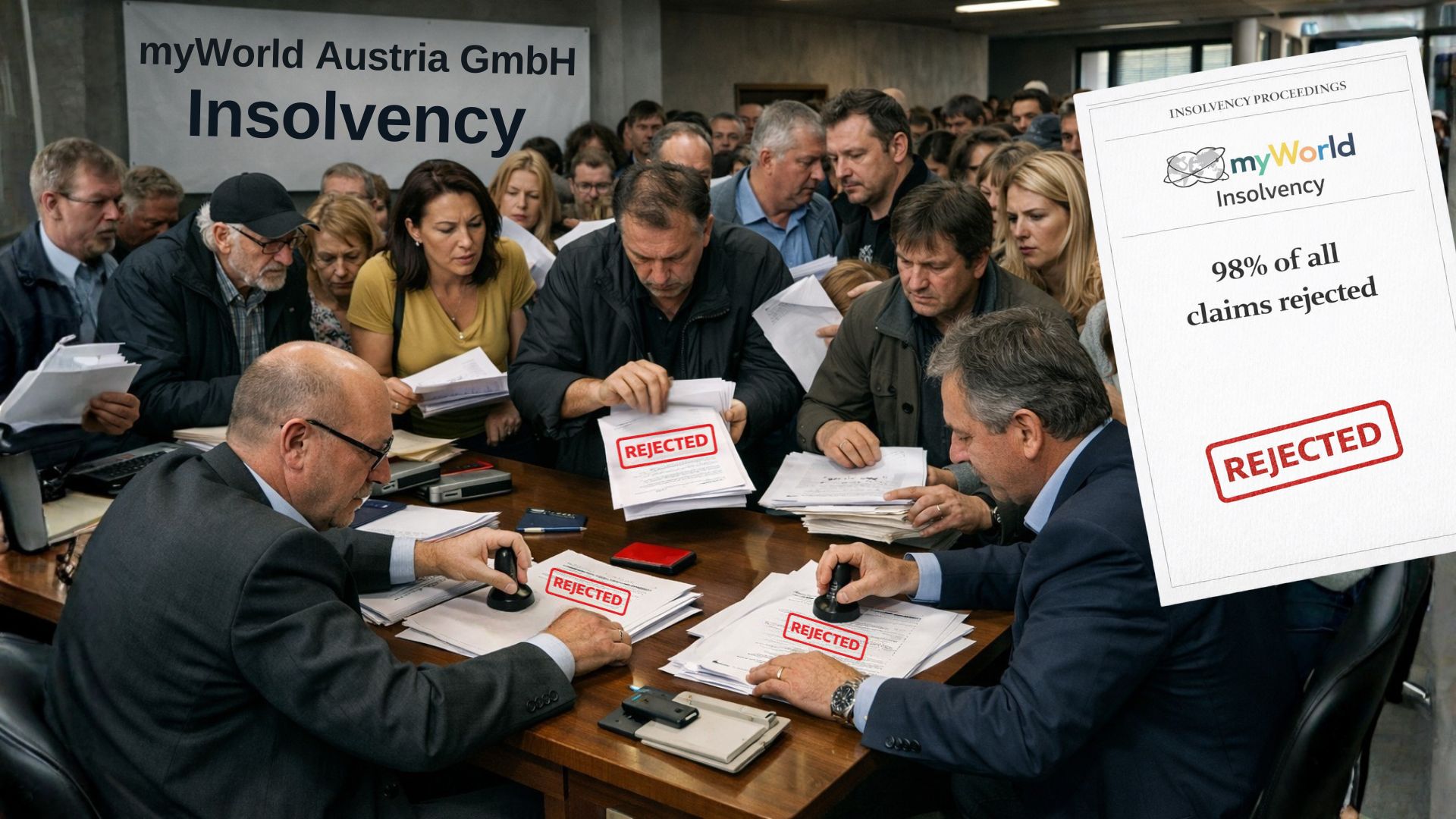
Insolvency as a total loss: 98% of claims rejected – only €174,000 out of €7.9 million recognized.
A report that leaves no room for illusions.
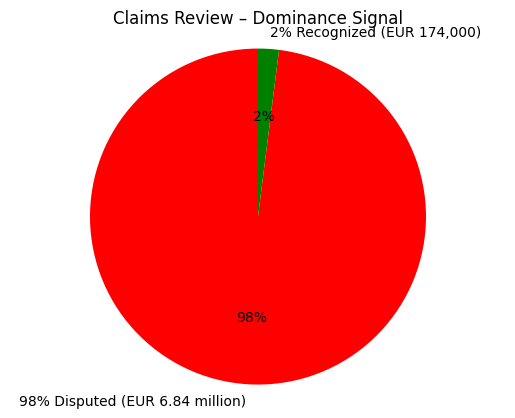
The further report by the insolvency administrator dated February 2, 2026, regarding the insolvency of myWorld Austria GmbH leaves no room for interpretation. With unusual clarity, it confirms that there is no significant insolvency estate, no realistic quota, and no scope for lenient solutions . Of the approximately EUR 7.9 million in claims filed , only around EUR 174,000 were recognized ; roughly 98% of the claims were disputed . This makes it clear that previous judgments are often ineffective if they were not issued directly against the debtor itself and are not recognized under insolvency law. The established insufficiency of assets means that the available approximately EUR 110,000 will be completely consumed by settlement costs. Marketers are in a particularly difficult position , as they are not legally considered typical consumers and their claims regularly fail due to a lack of standing to be sued. The myWorld companies are passing off liabilities of approximately €3.3 million to each other. Economically, these claims are proving worthless. The insolvency proceedings effectively serve only as a formal winding-up process; creditor satisfaction is impossible.
Figures that say it all: 98% of the claims were disputed.
The report documents a consistent, legally binding approach taken by the insolvency estate:
- Claims filed: approximately EUR 7.9 million
- Approved: approximately EUR 174,000 (≈ 2%)
- Disputed: approximately EUR 6.84 million
The core message is clear:
Over 98% of all claims are disputed.
The insolvency administrator states unequivocally:
“Of the claims registered so far, totaling approximately EUR 7.9 million , only claims amounting to approximately EUR 174,000 have been recognized; the vast majority of the claims have been disputed.”
Why almost everything is denied – the legal logic behind it
The vehement denial is neither blanket nor arbitrary. It follows a clear line of argumentation, upheld by the highest court:
- No transfer of contracts for Lyoness/ Lyconet products
→ expressly based on several Supreme Court decisions - Lack of passive standing of the debtor
- Consumption not verifiable
- Statute of limitations
- Nullity under capital maintenance law of alleged contract transfers
The report gets straight to the point:
“A significant portion of the claims had to be contested because the debtor lacked standing to be sued.”
This makes it clear: Formal contractual partner issues are the key lever for defending against creditor claims.

Previous rulings: Why many titles are unsuccessful
The consequences are particularly serious for creditors who have already obtained judgments. The report makes this clear:
- Legally binding judgments only help if…
- were issued against myWorld Austria GmbH itself and
- the claim is recognized under insolvency law.
- Judgments against other group companies (e.g. Lyoness Europe AG, Lyconet )
→ do not automatically establish liability for the debtor.
The insolvency administrator states this clearly:
“The claims against affiliated companies stated in the insolvency application prove to be de facto entirely uncollectible in view of the collapse of the myWorld or Lyconet group.”
Mass inadequacy: Why there is no room for maneuver
A key finding of the report is the ongoing insufficient assets.
The available insolvency estate amounts to only around EUR 110,000 – and will be completely depleted.
“The budget for data backup alone is around EUR 30,000. Further costs for data analysis, auditing and claims enforcement will completely consume the existing data.”
It also states:
“Based on current information, no substantial increase in assets is to be expected from the existing assets.” “The insolvency estate will be completely depleted by liquidation costs; no significant creditor satisfaction is to be expected.”
The crucial point is:
This is not a prediction, but a statement of fact – with an inevitable consequence:
Any claim that is not legally sound must be contested.
Why marketers are in a particularly bad position
The report clearly shows that marketers are not typical consumers, but act entrepreneurially due to the system.
This means less consumer protection, stricter legal attribution, and a higher burden of proof and presentation.
Many claims therefore fail due to a lack of standing to sue, an unclear legal basis, or their classification as an entrepreneurial risk.

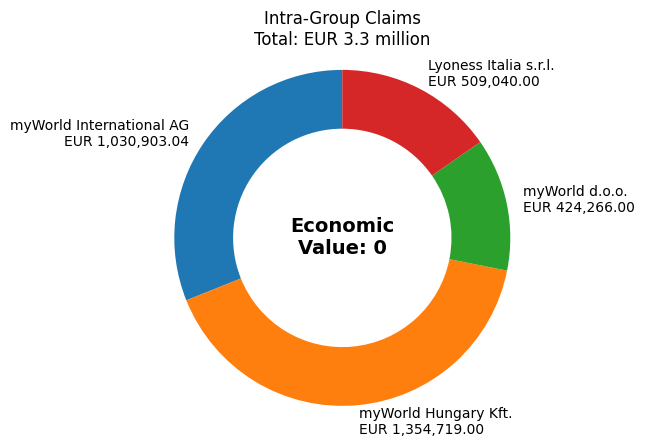
Particularly revealing is the look at internal claims filed by the group, which were almost unanimously contested:
- myWorld International AG: EUR 1,030,903.04
( itself insolvent and lacking sufficient assets – no audit process) - myWorld Hungary Kft .: EUR 1,354,719.00
- myWorld doo: EUR 424,266.00
- Lyoness Italia srl .: EUR 509,040.00
Total amount: approximately EUR 3.3 million
. No recognition, no economic value.
From cash outflow to creditor role – a familiar pattern
The current creditor role of those group companies that have transferred considerable funds to Lyoness Europe AG in Switzerland over the years – a company that is now itself insolvent – seems particularly contradictory.
The flow of money is clearly documented:
not horizontally, but consistently upwards, away from the operational units.
The fact that these same companies are now appearing as creditors in the insolvency proceedings is hardly explainable from an economic perspective. These are not classic business relationships, but rather intra-group profiteering and financing.
The pattern is clear:
money was centralized, risks were decentralized – and in the end, emptiness remained everywhere.
Conclusion: Contesting is a duty – not a strategy.
The massive denial of claims is neither corporate protection nor a political strategy.
It is the inevitable consequence of:
- virtually non-existent insolvency assets,
- clear Supreme Court case law on contract transfer,
- and the strict obligations of insolvency law.
Or in a nutshell:
The problem is not the insolvency administrator , but the legal and economic reality he has to implement.
For creditors, especially marketers, this means, quite simply and clearly:
there is no realistic prospect of satisfaction in these insolvency proceedings.
A notice:
This article presents a journalistic analysis. It is based on currently available information, documents, and third-party information. All persons and companies mentioned are presumed innocent until a legally binding decision is reached. Factual assertions and assessments are presented separately. Those affected have the right to comment or submit a counterstatement at any time (Article 5 of the German Basic Law / Article 10 of the European Convention on Human Rights).





Leave a Reply
Want to join the discussion?Feel free to contribute!