
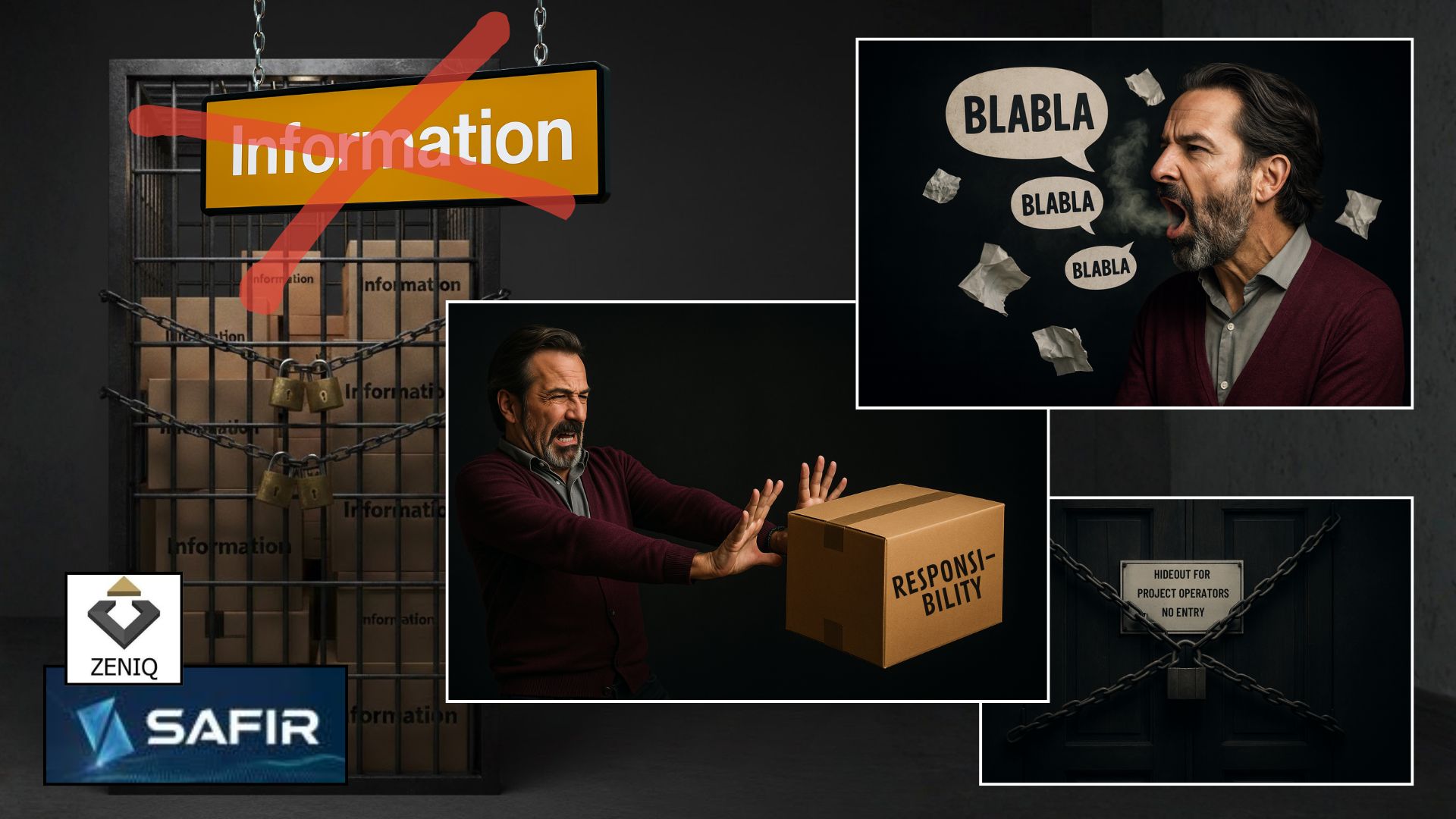
Safir/ZENIQ Update Call: Gernot Winter’s Briefing That Fails to Brief
In a recently held video call, Gernot Winter ostensibly addressed questions about the status of the once-touted, “revolutionary” Safir/ZENIQ projects. Winter is co-founder of Avinoc/VOO and, via RAMZIQ and Zentatec GmbH, is connected to Safir/ZENIQ founders Erwin Dokter and Peter Skerl. What stood out in Winter’s remarks was not necessarily what he said, but how often and in which contexts he emphasized certain points.
Safir/ZENIQ: The Never-Ending Story of a Project Pyramid
For years, the Safir/ZENIQ ecosystem was promoted as a visionary environment meant to connect real-world projects, tokenization models and blockchain innovation. Yet this call with Gernot Winter – one of the few remaining figures still willing to speak publicly – reveals the frayed structure behind what once appeared to be a polished operation. Winter provides the audience with no substantive information about the whereabouts of the invested funds or the status of the projects. He manages to speak for over an hour while saying virtually nothing concrete about the collapsed initiatives – projects for which no one now seems willing or able to give a reliable update.
Safir/ZENIQ “Marketplace”: Sales Yes, Responsibility No?
At the beginning, Winter repeatedly stresses the independence of the various network partners: each project, he insists, had its own “Product Owner,” complete with its own legal representative, external interface, and operational setup.
The sales platforms – Safir/ZENIQ, later Xera/XPRO and LayerK – were, according to Gernot Winter, merely distribution channels, comparable to marketplace operators like Amazon. On the surface this may sound reasonable, but within the context of the ZENIQ ecosystem it leads to an absurd result:
These platforms promoted, marketed, and sold products with great fanfare and even organized incentive programs to push them. Yet the actual project operators have remained – and still remain – largely invisible. And now that everything has gone wrong, the responsibility is conveniently shifted to these supposedly “independent” Product Owners, many of whom are no longer reachable or have effectively disappeared from the projects altogether.
The fatal flaw of this nebulous structure – typical of many MLM-style crypto schemes – is that in the end no one is accountable. Winter’s sobering conclusion: “It is difficult to determine what the actual legal situation is.”

Minters, Tokens, Hubs: “Products, Not Investments”
Another of Gernot Winter’s statements raises eyebrows: the projects, he insists, were not sold as investments but as products. In legal terms, this distinction is significant – and he repeats it unusually often and with marked emphasis. Many buyers, however, purchased tokens, hubs, mining packages or license models with the expectation of returns, token value appreciation and payouts.
Is this, perhaps, a legal maneuver designed to extinguish any hope of compensation right from the start?
Because when something is framed as a product purchase, then typically there are no guaranteed returns, no prospectus requirements, no liability for investment advice or mediation, no claims for lost profits, and no regulatory obligations as would apply to financial instruments.
By insisting on this framing, Gernot Winter shifts all responsibility for losses onto the buyers, essentially implying: “You purchased products. The risk was yours.” That many of these so-called “products” were marketed exactly like investment offerings is conveniently omitted in this argument.
When things go wrong, the phrase “It was only a product” helps no one. Instead, Winter uses it to once again divert responsibility away from Safir/ZENIQ – toward Product Owners who, in many cases, cannot be located at all.
The Narrative of Individual Responsibility
By emphasizing that each user acquired their tokens, hubs, software licenses or package products independently, Winter draws yet another legally relevant line. His statement suggests that there was no advisory relationship, no recommendation, no brokerage activity, and no legal connection to the platform operators – therefore, no basis for any claims against them.
Taken together, Gernot Winter’s comments read as an attempt to retroactively remove himself, the platforms, and his own role from the center of responsibility – by shifting blame onto a diffuse network of third parties that can barely be identified after the fact.
Hinweis:
This article is a journalistic analysis. It is based on publicly available sources. It is not a legal assessment or financial advice. All assessments have been researched to the best of our knowledge and are marked as opinions within the meaning of Art. 10 ECHR / Art. 5 GG. Counterstatements will be taken into account in accordance with § 56 RStV.
Sources
- “Support Old Safir Community” Telegram Gruppe
- Complete Recording of the Call from 7. December 2025 (Winter/Okanovic)
- Own Verification (Editorial Team): data, domain/company check, backup of the call and all relevant screenshots.


Leave a Reply
Want to join the discussion?Feel free to contribute!