

Homnifi, LayerK & Co.: Aliases, jungle-like terms and conditions, and suspicions of a money-grabbing scheme
They promise the digital revolution: Homnifi, LayerK, NodeK, CloudK, and Horysmall advertise with flashy buzzwords related to Web3, blockchain minting, and NFTs.
But what presents itself as a modern investment ecosystem turns out, on closer inspection, to be a labyrinth of almost identical contracts, interchangeable company names and a cacophony of cryptic token terms. Behind this façade, a disturbing impression emerges: confusion could be deliberately created here, possibly to keep investors in the system and cleverly distribute legal risks.
Contracts without signatures – and still trapped?
The central element of the criticism: a document that users are supposed to sign via DocuSign in order to gain access to their ‘back offices’. However, many do not sign it and are still harassed. According to Homnifi’s terms and conditions (T&Cs), simply logging in is sufficient to be considered contractually bound. Whether you have ever actually provided a digital signature seems to be irrelevant.

Those affected report that they nevertheless repeatedly receive reminders and copies of the terms and conditions, accompanied by the claim that they are already bound by the terms. Legally, this approach is highly questionable if the platform has not actually been used. It seems like a ploy to build up pressure.
Too many questions seem to be undesirable at Homnifi.
Even more serious is Homnifi’s handling of critical inquiries. Users who request a copy of the terms and conditions from alleged partner companies such as ‘Kmall’ receive no response. Requests for a signed agreement directly with Homnifi also remain unanswered. Anyone who wants to know what they are actually signing or who they are entrusting their money to is met with a wall of silence.
In a complex system that manages millions of digital assets, this lack of transparency is a massive red flag.

Many names, one sender
A look at the contracts reveals a bitter truth: Regardless of whether Homnifi, NodeK or CloudK is on the paper, you always end up with LayerK Group LTD, a company based in the British Virgin Islands. The supposedly independent projects NodeK and CloudK are based on almost identical contracts. Only the product names and a few technical terms vary. The rest – from disclaimers to choice of law – is almost identical.
This similarity raises a suspicion: the multitude of company names is primarily intended to conceal one thing – that at its core, it is one and the same construction. Diversity is suggested to the outside world. In reality, LayerK controls everything centrally. A classic means of diffusing responsibility and confusing customers.
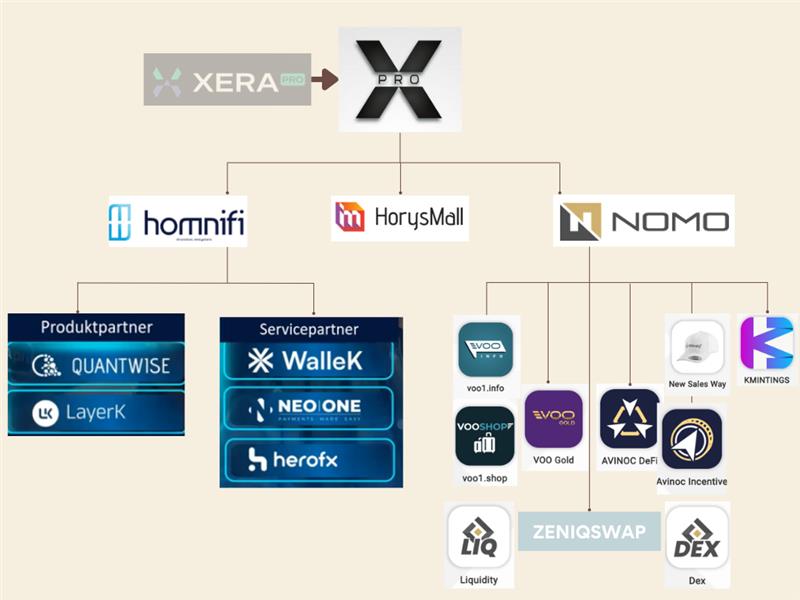
Technical jargon as a smokescreen
Added to this is a veritable fireworks display of technical terms: USDK, mLYK, sLYK, cLFi, Generational Decline, Boost Value. Every week, a new name for alleged digital values seems to emerge. But what these tokens really mean remains unclear. Users report that new internal currencies are suddenly being introduced, while old ones are losing their meaning. Many no longer even know which tokens they own – let alone whether they can ever be cashed out.

One particularly alarming aspect is that the minting agreements of NodeK and CloudK contain cryptic passages about NFT-based licences, hardware links and reward systems. Even for experts, it is difficult to understand how real value is supposed to be created here – or whether everything is just accounting entries in a closed system.
Liability? None.
A common thread runs through all the documents: liability is categorically excluded. Neither Homnifi nor LayerK guarantee any increase in the value of the tokens. All transactions are ‘final, irrevocable and non-refundable.’ In the event of cyber attacks, technical failures or loss of value, the customer is left to bear the loss. At the same time, the providers reserve the right to unilaterally change the terms of the contract at any time.

The terms and conditions state unequivocally:
‘Homnifi accepts no liability for any adverse consequences arising from the use of the platform.’
LayerK’s minting contracts repeat this message almost word for word. For customers, this means that anyone who invests bears the full risk alone.
Confusion as a business model?
The parallels between the documents and the changing brand names increasingly give the impression of deliberate opacity. Users report that support requests are regularly dismissed on the grounds that they are being handled by a ‘different department’ or even a different company. Yet the terms and conditions of all the supposedly independent companies are identical in every detail and ultimately lead back to LayerK.
It looks like a ‘matryoshka system’ – lots of colourful shells, but only one core.
A system that is so convoluted makes it difficult for investors to enforce claims or even find their way around. This could be a deliberate strategy.

The smouldering Ponzi suspicion
More and more voices are voicing a drastic suspicion: that Homnifi and LayerK could be a system that structurally bears the hallmarks of a Ponzi scheme. New users are lured in with fresh capital, while payouts to existing investors become increasingly difficult. Instead of real value creation, a cycle emerges in which the money from new investors is used to service old claims.
There is no evidence of a criminal Ponzi scheme as yet. However, the behaviour of the companies, in particular their strict silence in response to enquiries and their complete lack of transparency, is setting alarm bells ringing.
Conclusion
Homnifi, LayerK and their satellite projects cloak themselves in the glossy vocabulary of modern blockchain technology.
But the reality behind it seems to be a system of complex, partly identical contracts, interchangeable company names and a multitude of opaque tokens. Everything seems designed to keep investors in their own ecosystem, minimise liability risks and make transparency difficult.
For investors, therefore, only one thing applies: extreme caution. Anyone investing money here must expect that, without professional help, they may never see their money again and will be unable to enforce any rights against the thicket of corporate structures and legal clauses.
The crucial question remains: Is this merely a highly complex, legal Web3 experiment, or is it a system that wants one thing above all else: its users’ money? Homnifi and LayerK have yet to provide an answer.
Note: This article is intended solely for informational purposes, journalistic analysis and independent opinion-forming in accordance with Article 5 of the German Basic Law and Section 51 of the German Copyright Act (UrhG) (right to quote). All information is based on publicly available sources, official communications and careful editorial research. Despite taking the utmost care, we cannot guarantee the accuracy, completeness or timeliness of the information contained herein.
Companies, individuals or projects are mentioned on the basis of verifiable research and clearly identified expressions of opinion. Publication is protected by the constitutionally guaranteed freedom of the press. Contributing sources are subject to editorial source protection in accordance with journalistic standards.
Sources:
Cybercriminal.com (2024): Homnifi.com Review – High Risk Business, Scam Allegations. Available online at: https://cybercriminal.com/review/homnifi.com
Trustpilot (2024): User reviews of Homnifi. Available online at: https://www.trustpilot.com/review/homnifi.com
IYE Global (2024): Homnifi and the Web of MLM Scams – Success Factory, WEWE, Xera Pro. Available online at: https://iyeglobal.com/reports/homnifi-scam-links
Financial Markets Authority (FMA) New Zealand (2024): Warning: Homnifi associated with Xera Pro and unregistered financial services. Available online at: https://www.fma.govt.nz/library/warnings-and-alerts/homnifi-xera-pro/




Leave a Reply
Want to join the discussion?Feel free to contribute!