

‘Cashback Universe’ after myWorld bankruptcy – between Phoenix promises and creditor risk
On 14 August 2025, Max Galler addressed the unsettled marketers of ‘Cashback Universe’ in a community call. Officially, the meeting was intended to provide guidance following the bankruptcy of myWorld International AG. However, analysis of the statements reveals that Instead of transparency, blame, exaggerated promises and dangerous signals for those who have already lost money and trust dominated.
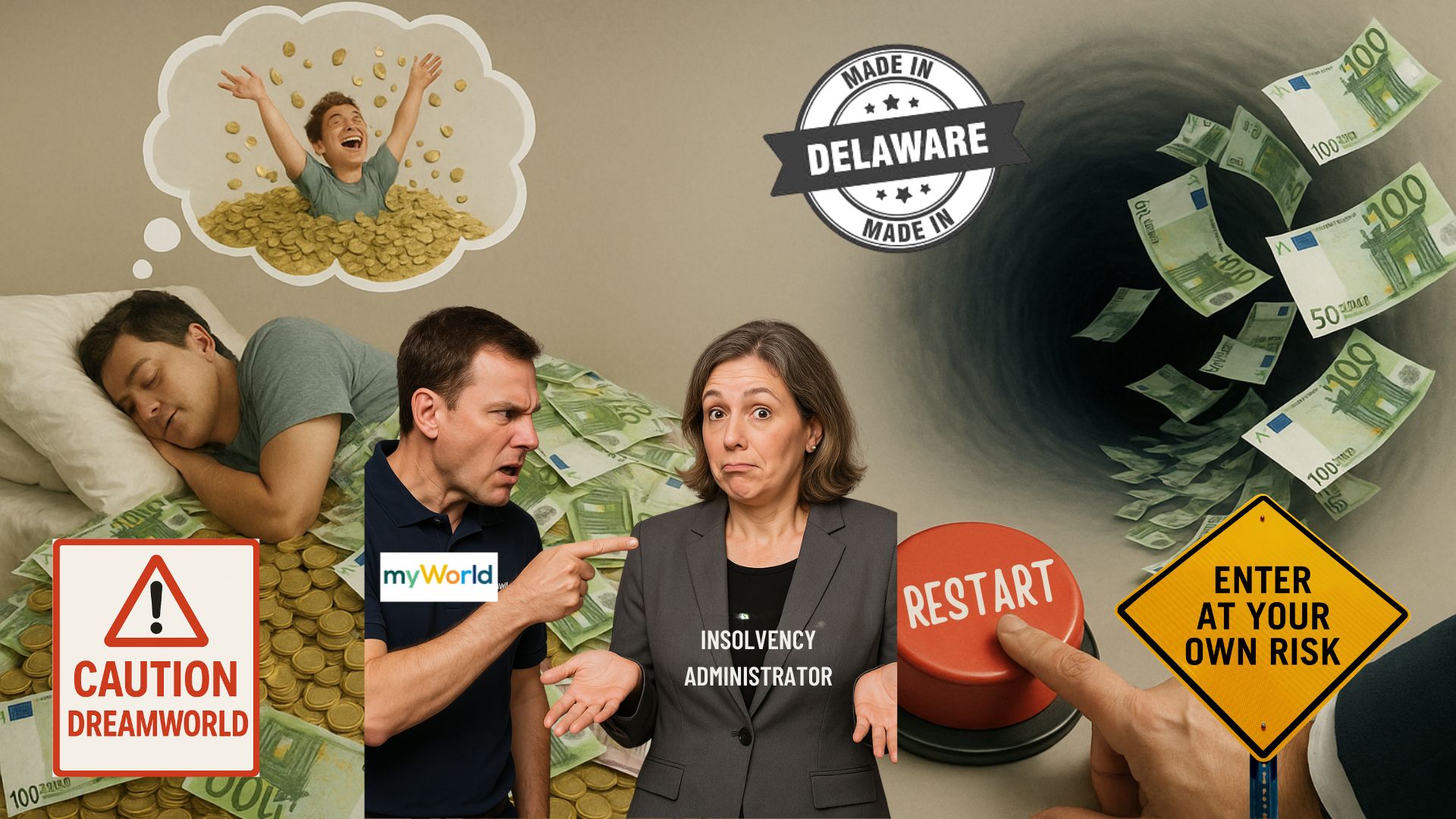
The insolvency administrator as scapegoat
Galler portrayed the insolvency administrator in a dual role: on the one hand, as a possible ally in a new asset deal, and on the other, as the person responsible for allegedly blocked commissions. ‘She didn’t understand that the sales come from us,’ he explained, suggesting that the administrator had ‘booked the marketers’ commissions en masse.’
Legally, this is misleading: commissions are insolvency claims and must be treated on an equal footing with all other creditors. Anyone who promises special rights here calls into question the principle of equal treatment of creditors. Galler’s presentation carries the risk that marketers will misjudge their claims and blame the administrator for their own losses instead of the company’s management.

Excessive quota promises
‘50 to 60 percent of outstanding claims will definitely be covered,’ Galler announced, a quota that is virtually utopian in everyday insolvency practice. It was justified by ‘millions in frozen assets’ and existing assets.
Such statements are dangerous: anyone who relies on quota promises instead of waiting for the official insolvency proceedings could develop unrealistic hopes and make wrong financial decisions. Creditors run the risk of once again being drawn into expectation management that is not based on reliable facts.
The asset deal sold as a ‘rescue’
A key element of the call was the prospect of a cooperation partner who, together with the insolvency administrator, would ‘buy out’ dealer, customer and system data and transfer it to a new structure. This is currently believed to be Enigmatic Smile LLC, based in London. However, Mr Bish is reluctant to answer any questions on this matter.
But this is precisely where the greatest risk lies:
- Creditor disadvantage: When valuable assets are transferred to a new company while old claims remain, the classic pattern of a ‘Phoenix Company’ emerges.
- Data protection: The transfer of customer data without a clear legal basis could constitute a serious violation of the GDPR.
- Repeat effect: Marketers who have already suffered losses could be tempted by the prospect of a ‘smooth transition’ to make payments into a new system again.

Reversing blame instead of addressing the issues
Instead of presenting a clear analysis of the causes of myWorld’s bankruptcy, Galler resorted to shifting the blame:
- The insolvency administrator blocked the process.
- The tax office had ‘delivered the coup de grâce’.
- The sales department had done everything right.
This is a dangerous narrative for existing marketers. It distracts from the real problem: for years, payments were channelled into structures whose sustainability was questionable. Instead of taking responsibility for the business models, it is now being suggested that a fresh start could offset the losses.

The hidden danger for marketers
The combination of quota promises, blame and the prospect of a ‘fresh start’ poses considerable risks for existing marketers:
- Misleading claims: Anyone who believes that 50–60% is guaranteed may decide not to take legal action.
- Incentive for new payments: The prospect of a ‘smooth transition’ could lead old victims to invest again.
- Loss of creditor rights: If assets are transferred to new structures without creditors being adequately compensated, there is a risk of de facto disenfranchisement.
This raises the risk that the old patterns of collecting money, promising future compensation and shifting responsibility will continue.
Conclusion: Phoenix threat instead of a new beginning
The call on 14 August 2025 made it clear once again: instead of transparent information, ‘Cashback Universe’ is relying on promises of rescue, reversal of blame and emotional attachment to the marketers.
The administrator is portrayed as an obstructionist, while at the same time the prospect of a takeover by a ‘cooperation partner’ is held out – with all the risks of continuation under a new name. For marketers, there remains the risk that they will once again become a financing factor for a system that leaves their old claims behind in insolvency proceedings.
Those who really want clarity should not rely on community calls.
Note: This article is intended solely for information, journalistic analysis and independent opinion-forming within the meaning of Article 5 of the German Basic Law and Section 51 of the German Copyright Act (UrhG) (right to quote). All information is based on publicly available sources, official announcements and careful editorial research. Despite the utmost care, we do not guarantee the accuracy, completeness or timeliness of the information contained herein.
Sources / Status
- Cashback Universe Call, 14 August 2025 (own transcript / evaluation)
- Insolvency Code (Austria, Germany): Sections 47 ff IO / InsO – rights of separation, equal treatment of creditors
- GDPR: Art. 6, 21 – legal basis for data transfer
- Own research, as of 16 August 2025





Leave a Reply
Want to join the discussion?Feel free to contribute!