
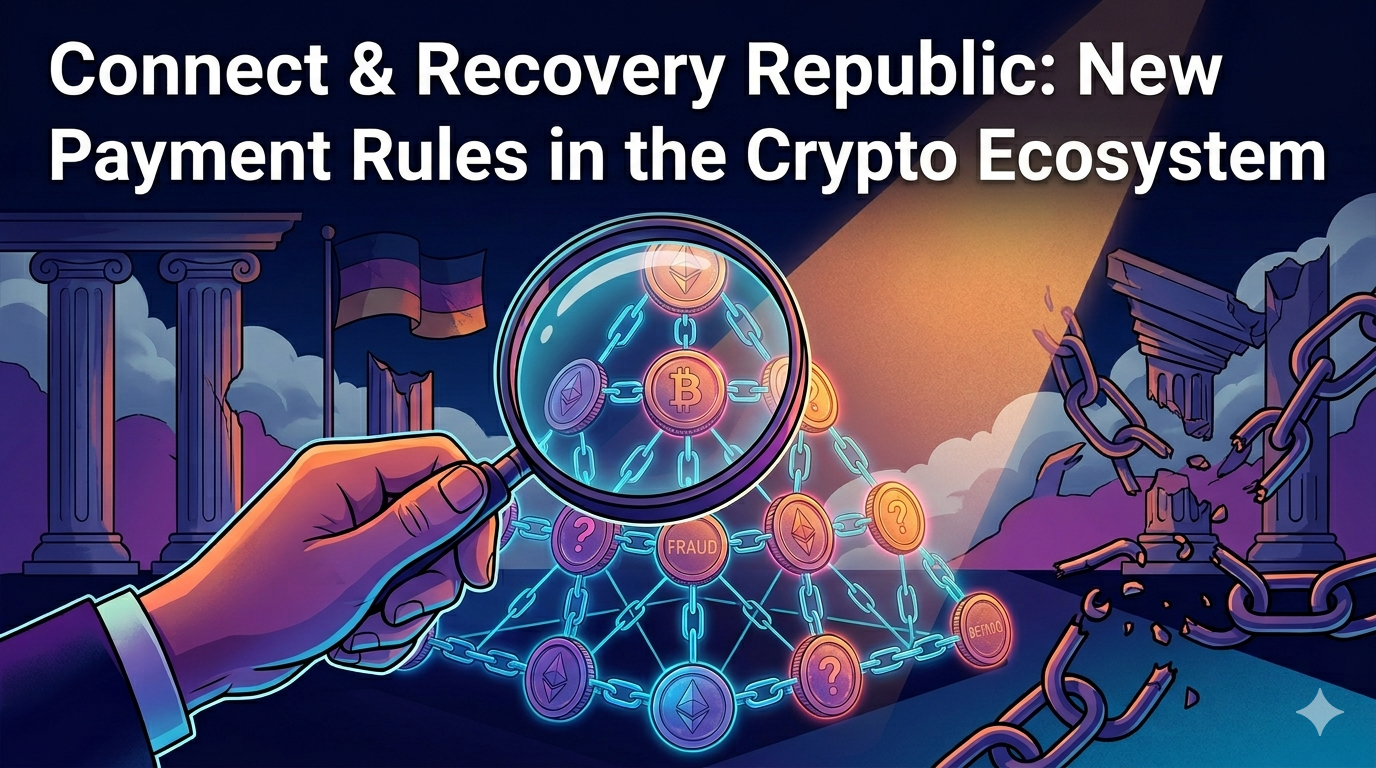
Connect & Recovery Republic: New Payment Rules in a Crypto Ecosystem
With a recent announcement, the crypto network Connect has introduced a significant change affecting its entire ecosystem. Going forward, all purchases across connected projects must follow a fixed structure: 80 percent in cryptocurrency and 20 percent in an internal unit referred to as USC.
This new rule applies to a wide range of platforms and services within the network — including Recovery Republic, a project that has recently drawn attention with promises of returns and claims of turning failed cryptocurrencies into new investment opportunities.
The official rationale behind the change is to “optimize operational efficiency” and improve alignment across the ecosystem. However, a closer look reveals a number of underlying questions.
The Emergence of a Closed Payment Structure?
The introduction of a mandatory payment component in an internal unit like USC suggests a move toward a more closed ecosystem. While most of the transaction value remains in established cryptocurrencies, a meaningful portion is deliberately redirected into an internal system.
Such mechanisms are not new in the crypto space. They are often used to retain capital within a network and to control internal cash flows. At the same time, they reduce transparency. Internal units are typically not freely tradable, and their valuation is not determined by open market dynamics.
For users, this means that part of their capital is no longer operating in transparent, external markets, but within a system whose mechanics are difficult to verify independently.

Recovery Republic Within the Ecosystem of Connect
This development becomes particularly relevant in the context of Recovery Republic. The project promotes the idea of converting so-called “failed tokens” — cryptocurrencies that have effectively lost their market value — into new yield-generating opportunities. At the same time, the platform has recently announced the launch of new pools, including MATIC/USDC and BNB/BUSD, presenting this as a further step in the expansion of its system.
Combined with the new Connect payment structure, a broader picture emerges: Recovery Republic is not operating in isolation, but as part of a tightly interconnected ecosystem in which capital flows are increasingly managed internally.
Expansion Without Technical Context
The introduction of new pools is presented as a sign of growth and innovation. In the DeFi sector, such expansions are generally common and can indeed indicate development.
However, key technical details remain absent. There is no clear information on which platforms these pools operate on, what specific strategies are used to generate returns or how activity can be verified on-chain.
In decentralized finance, transparency is typically a core principle. Smart contracts, liquidity positions, and transaction histories are usually publicly accessible. In the case of Recovery Republic, this level of transparency is currently lacking.
The Question of Verifiability
This leads to a fundamental question: can the announced structures be independently verified? Legitimate DeFi pools are, by design, visible on-chain. They are associated with identifiable smart contract addresses, measurable liquidity (Total Value Locked) and publicly traceable transaction activity.
Without access to such data, it is not possible to confirm whether the described mechanisms actually exist or operate as presented. So far, Recovery Republic has not provided this information. No wallet addresses, smart contracts, or specific protocols have been disclosed that would allow independent verification.
Connect & Recovery Republic: Familiar Distribution Networks
Another critical aspect is the way these projects are being promoted. Connect itself builds on distribution structures that are already familiar within the crypto space, including networks previously associated with SAFIR, Zeniq, and their subsequent iterations.
These ecosystems consist of extensive community channels, Telegram groups, and referral-driven structures used to promote various crypto projects. Recovery Republic is now being actively circulated through these same channels. For observers, this reflects a recognizable pattern: new programs are rapidly scaled through pre-existing networks that already possess reach and a level of established trust within their communities.
Our Conclusion: Between Efficiency and Opacity
While the new payment rules are officially framed as a step toward efficiency and structural alignment, they also result in a greater share of capital being routed through internal mechanisms that are difficult to assess from the outside.
In combination with projects like Recovery Republic — which simultaneously promote high and unusually consistent returns — this creates a tension between the narrative of stability and the lack of verifiable transparency. The latest developments around Connect indicate a system that is becoming more structured and more tightly integrated. At the same time, this increasing complexity also raises the need for greater transparency.
Recovery Republic exemplifies this dynamic: a project with expanding features and ambitious claims, embedded within a broader ecosystem that operates under its own internal rules and payment structures. As long as key questions remain unanswered — particularly regarding the origin of returns and the technical implementation — one conclusion remains: this is a system that continues to evolve, but whose underlying mechanics remain difficult to independently verify.
Note:
This article presents a journalistic analysis.
It is based on publicly available sources as well as original research and distinguishes between facts, assessments, and opinions . The evaluations of external sources reflect their respective assessments. No final legal or criminal assessment is made. Publication is in accordance with the freedom of the press guaranteed by Article 5 of the German Basic Law and Article 10 of the European Convention on Human Rights.
Sources:
- Publicly available profiles of the referenced projects (including Telegram channels/ groups); research status: April 2026
- Independent editorial analysis of webinars, marketing materials, and investor reports


Leave a Reply
Want to join the discussion?Feel free to contribute!