

Lyconet/myWorld Norway – When a ban isn’t enough
Illegal system, legal inaction by authorities
Norway is considered a state governed by the rule of law with clear rules. Pyramid schemes are prohibited, and consumer protection and economic oversight are institutionally enshrined. And yet, the Lyconet case demonstrates how ineffective even clear official findings can be when responsibilities are shifted, proceedings are discontinued, and accountability is passed on.
Back in 2018 , after a two-year investigation , the Norwegian Lottery Authority reached a clear conclusion: Lyconet and its affiliated companies Lyoness and myWorld met the criteria of an illegal pyramid scheme. The authority ordered the immediate cessation of all activities in Norway .
The figures are documented: According to official data, around 175,000 Norwegians invested more than 500 million kroner without receiving any real products of independent economic value in return.
And yet: The system did not disappear.
“Sell nothing, earn money from everything”
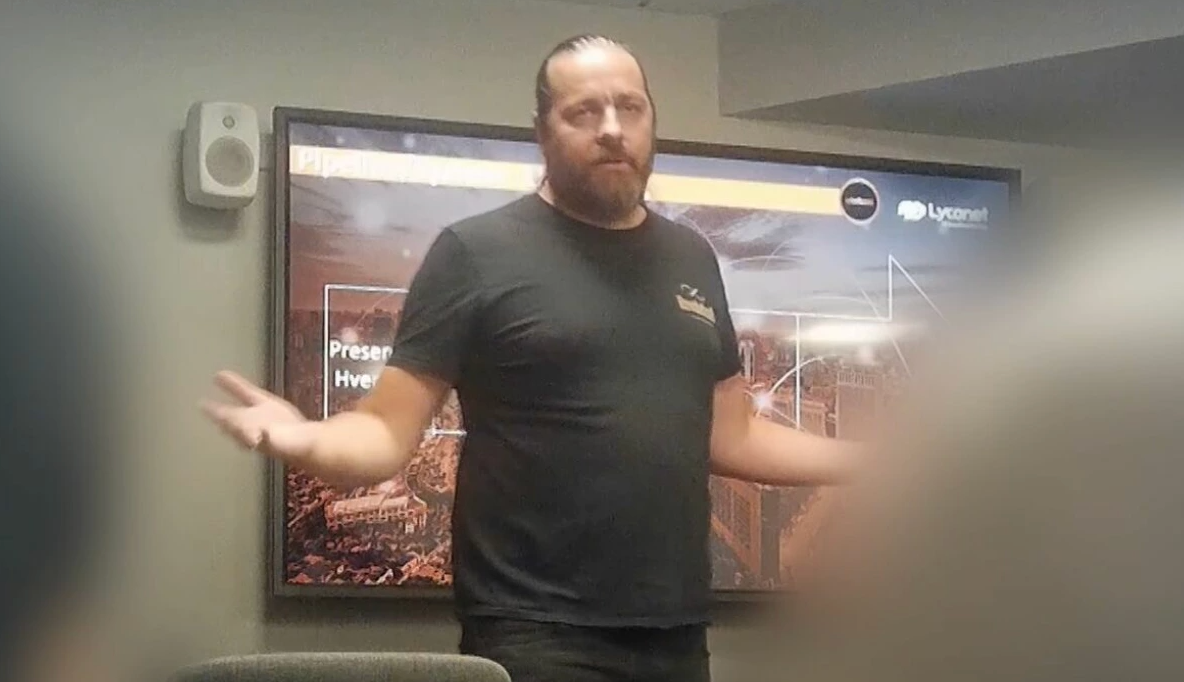
In a conference room of a hotel in Oslo, Arnt Grønbech explains the business model to a small group of interested people. The goal is to recruit friends and family. Their own efforts will pay off.
According to TV 2 , Grønbech says:
“There is no better income than selling nothing and making money from everything.”
Such statements are highly problematic from a legal standpoint. Under Norwegian law, pyramid schemes are characterized precisely by the fact that income derives predominantly from recruiting new participants – not from selling actual products or services to external customers.
Grønbech did not respond to inquiries from TV 2 regarding these allegations.
Determined – but without consequences
In 2018, the lottery supervisory authority decided to refer the case to the police. The proceedings were later discontinued due to a lack of resources . This decision explicitly did not exonerate the business model itself.
However, leading Lyconet marketers still use this fact as an argument to portray the system as legitimate. Terje Duesund , who for many years was one of Lyconet ‘s most recognizable faces in Norway, plays a central role in this.
Duesund explained that the discontinuation of the proceedings was proof for him that Lyconet was not violating Norwegian law. Legally, this conclusion is untenable: the discontinuation of proceedings due to a lack of resources does not constitute legal exoneration .
Responsibility in the roundabout
Today, oversight of such business models lies with the consumer protection agency , not the lottery authority. Deputy Director Marit Evensen explained to TV 2 that the old case cannot simply be carried over. It must be reassessed – a process that ties up considerable resources. Furthermore, pyramid schemes are not a priority.
The responsible Ministry for Children and Family disagrees: They expect the authority to exercise its professional discretion independently. Økokrim, in turn, explains that pyramid schemes are also not a priority ; they are focusing on prevention.
a Nordic police report from 2024 , in which Økokrim participated, concludes that prevention efforts have “little to no effect” on such systems .
The result: Everyone blames each other. No decisive action is taken.
Rename instead of reworking
Lyconet ‘s insolvency in 2025, members were reportedly asked to continue their activities in newly named structures – most recently under the name TLN , according to multiple media reports .
Legally, these are separate entities. Critics, however, see this as a recurring pattern: renaming instead of addressing the issues , new brands instead of taking action. This approach significantly hinders both criminal prosecution and civil enforcement.

Victims without access to information
In the current season of “Norge bak” Several people affected by the “ fasaden ” report significant losses. One participant lost a large portion of his deceased father’s inheritance. Many describe having no insight into financial flows, the use of funds, or actual business operations .
When asked how he deals with people feeling deceived, Duesund explains that fraud can only occur if the company itself provided false information or misused funds. He cannot judge whether this was the case – he had no insight into the matter.
This statement points to a central structural problem: lack of transparency is not a side effect, but systemic.
Conclusion: Laws without enforcement
The Lyconet case demonstrates less a failure of individuals than a structural problem with state oversight . Laws exist, findings have been made, and damages have been documented. And yet the system was able to persist for years – under different names, but with the same mechanisms.
This assessment represents a journalistic evaluation . It is based on official decisions, public statements, media investigations, and documented experiences of those affected.
As long as responsibilities are more important than consequences, a bitter reality remains for many victims:
behind the facade, they are left to fend for themselves.
Notice / Legal Information
This article presents a journalistic analysis. It distinguishes between official findings, documented statements from third parties, and the editorial team’s evaluative assessments. It does not imply any legal judgments. Right of reply will be respected in accordance with applicable media law provisions. Art. 5 GG / Art. 10 ECHR.







Leave a Reply
Want to join the discussion?Feel free to contribute!