
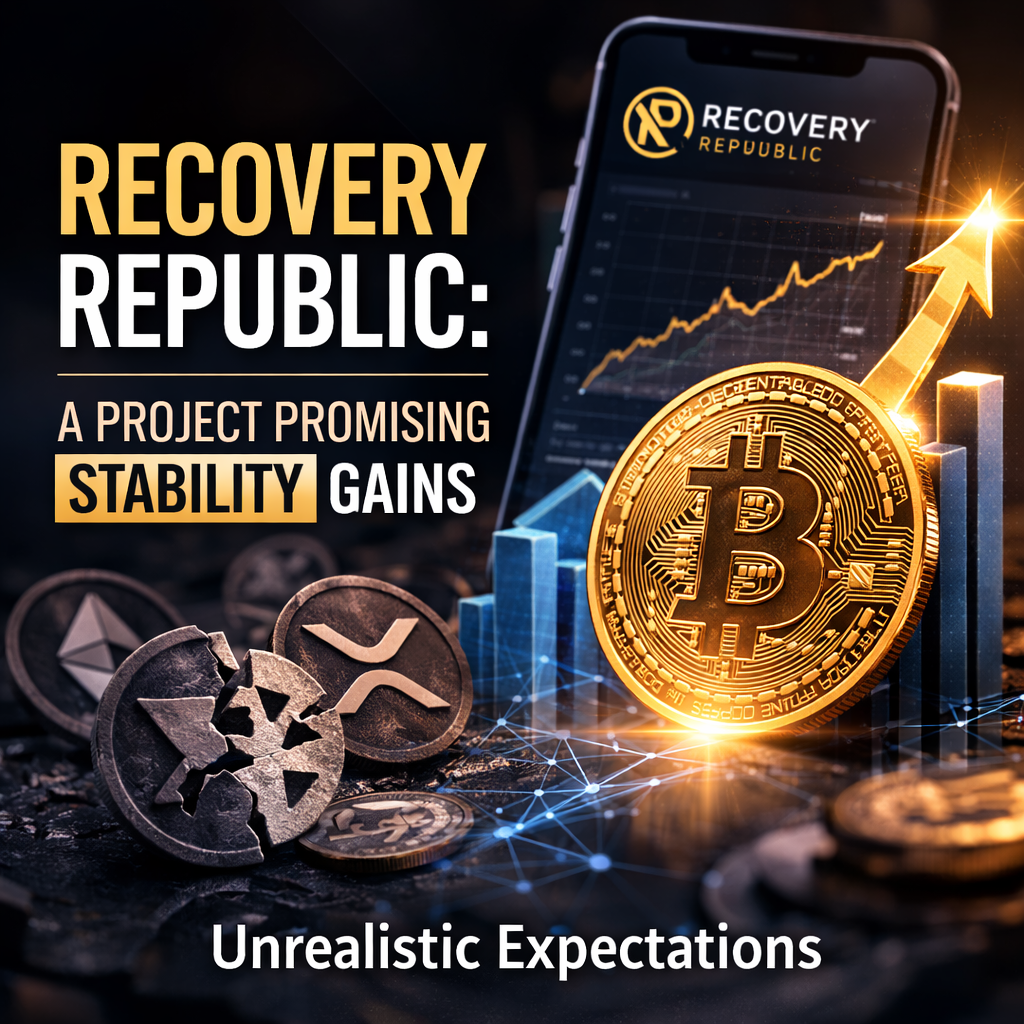
Recovery Republic: Alleged Rescue for Lost Tokens
Recovery Republic: A Project That Markets Stability
In the cryptocurrency market, new platforms regularly emerge promising high – and at the same time stable – returns. One such project is Recovery Republic, a platform that claims to transform failed cryptocurrencies into new investment opportunities.

Its visual presentation follows familiar patterns of financial marketing: dark backgrounds, gold elements, and prominent crypto symbols designed to convey professionalism and stability. At the same time, however, it remains unclear what specific strategy is supposed to generate these consistent returns.
In a market known for strong volatility, a sequence of uniform monthly returns without any visible loss periods inevitably raises questions about how such a system actually works.
Recovery Republic: Return Promises in a Volatile Market
In promotional graphics and on its website, the project presents a series of monthly returns ranging between six and eight percent. If profits were reinvested, this would translate into an annual return well above one hundred percent. For the period from September 2025 to February 2026, only positive months are listed. The presentation is accompanied by terms such as “structured liquidity,” “strategic positioning,” and “long-term community.”

In the DeFi sector, high returns can occasionally occur — for example through liquidity providing, arbitrage, or leveraged trading strategies. However, such models typically come with significant fluctuations. Even professional crypto funds regularly report losing months or at least widely varying results.
A nearly linear performance over several months is therefore unusual and requires a plausible explanation. Yet this explanation is largely absent from Recovery Republic’s public communication.
Recovery Balance: The Idea Behind the System
A central element of the concept is the possibility of submitting so-called “failed tokens” — cryptocurrencies from projects that have effectively lost their market value. According to the platform’s description, users can submit these tokens for validation. They are then converted into an internal accounting unit referred to as the “Recovery Balance.” However, this balance is not a freely tradable asset. According to the documentation, it is an internal metric that cannot be transferred or directly withdrawn. Instead, it serves solely as a basis for calculations within the system.

At the same time, participants are required to deposit USDC. Recovery Republic describes the model as a type of matching mechanism: part of the capital comes from users, while the other portion is allegedly matched by the platform. Returns are then supposed to be generated from this combined pool.
What specific strategies are used remains largely unclear. The platform does not identify particular DeFi protocols, wallet addresses, or smart contracts through which activity could be verified on-chain.
Participation Through a Paid License
To participate in the system, users must purchase a so-called “Recovery License.” This license functions as an entry point and defines, among other things, possible investment amounts and maximum potential returns.
Such models — where access to an investment program requires a paid license or membership — are not new in the crypto space. They are often combined with affiliate or referral programs designed to drive community growth.
Recovery Republic also operates such a referral system. Participants can receive bonuses for recruiting new members. Referral programs alone are not unusual. However, when combined with paid entry and promised investment returns, such structures are often viewed with increased scrutiny.
Promotion Through Familiar Crypto Networks
Another notable aspect is how the project is being promoted. In recent months, Recovery Republic has increasingly appeared in channels previously associated with the ecosystem around SAFIR International and the crypto project Zeniq Blockchain.
This ecosystem later continued under the name Xera.Pro / XPRO and is now promoted under the brand Connect.
These networks consist of numerous Telegram groups, community channels, and affiliate structures that have been used in the past to promote various crypto projects. Observers of the space have quickly noted that Recovery Republic is now being circulated through these same distribution channels.
For investors, this context can serve as an important warning sign. Projects heavily marketed through established referral networks often benefit from the trust that has already been built within those communities. At the same time, this dynamic can allow new programs to spread rapidly before their underlying business models have been critically examined.
Limited Transparency
Many observers also point to the platform’s limited transparency. Within the DeFi ecosystem, it is common practice to publish smart contracts, conduct independent audits, or at least disclose wallet addresses so that on-chain activity can be verified.
With Recovery Republic, much of this information is missing. The platform does not explain concrete trading strategies or provide technical details that would enable independent verification.
There is also little publicly verifiable information about the operators behind the project. The domain was registered only relatively recently, and clear information about responsible companies or individuals is difficult to find.
The Core Economic Question
The platform’s core promise is that even worthless tokens can become the basis for future returns. From an economic perspective, however, this concept raises fundamental questions.

In financial markets, value typically arises from real demand, productive use of an asset, or demonstrable trading profits. If tokens that have effectively lost their market value are suddenly supposed to form the foundation for investment returns, the mechanism by which this new value is created needs to be clearly explained.
So far, the platform has not provided a convincing answer to this question.
Conclusion
Recovery Republic presents itself as a platform aiming to make “lost value” from past crypto projects usable again while promising stable returns. Yet the combination of high monthly returns, limited transparency, and a strongly community-driven distribution model raises a number of legitimate questions.
Particularly striking is the fact that the project is being promoted primarily through existing crypto networks that have previously marketed other investment programs. For investors, this context alone may be reason enough to examine such an offering with particular caution.
As long as key questions about the system’s mechanics, the origin of its returns, and its technical implementation remain unanswered, Recovery Republic remains, above all, a project defined by big promises — and many unresolved issues.
Note:
This article is a journalistic analysis. It is based on publicly available sources. It is not a legal assessment or financial advice. All assessments have been researched to the best of our knowledge and are marked as opinions within the meaning of Art. 10 ECHR / Art. 5 GG. Counterstatements will be taken into account in accordance with § 56 RStV.
Sources:
- recoveryrepublic.io, Stand der Recherche: März 2026
- Independent editorial analysis of webinars, marketing materials, and investor reports

Leave a Reply
Want to join the discussion?Feel free to contribute!