
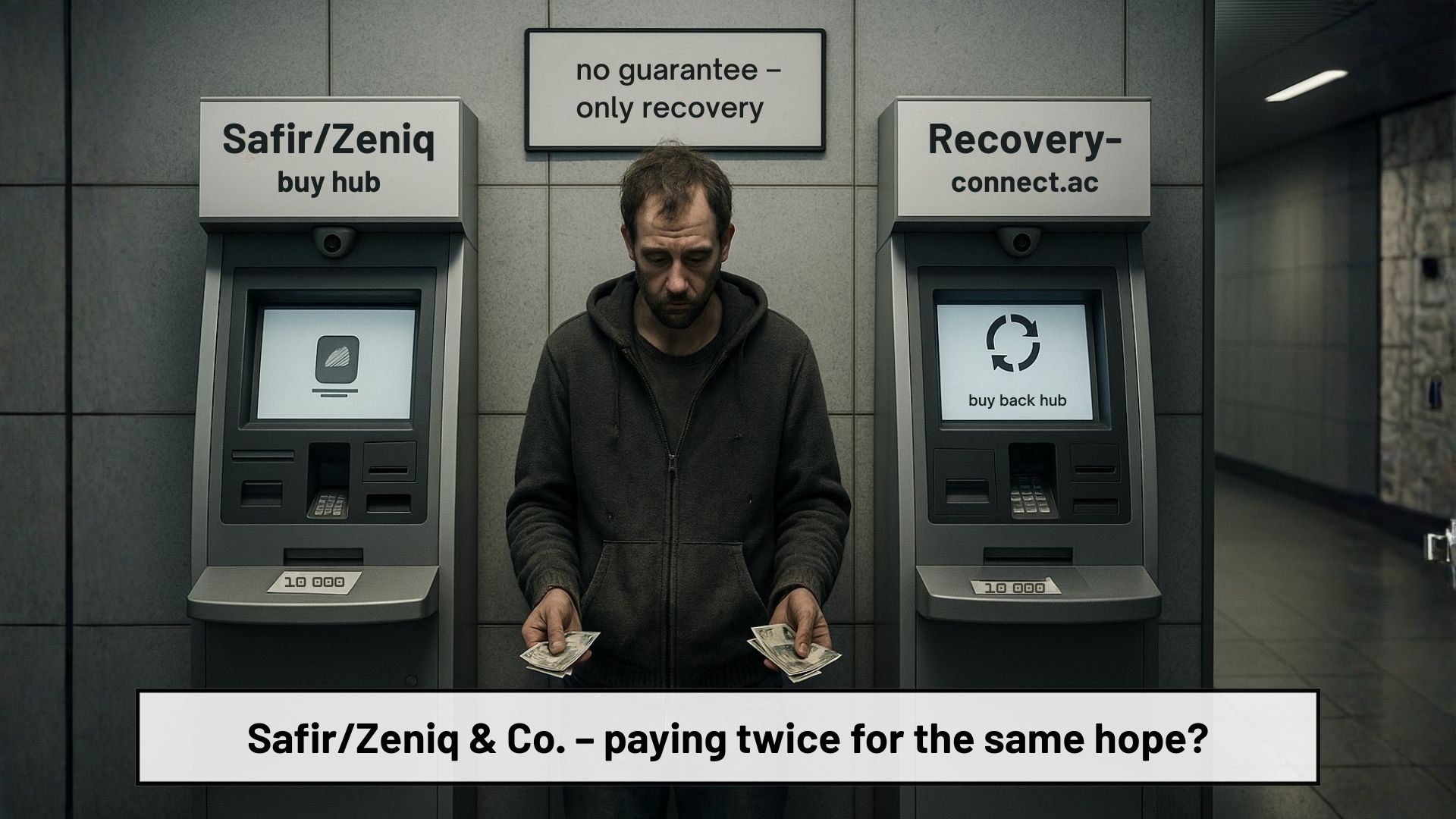
Rebranding with ‘Recovery’ – How Safir/Zeniq/XPRO victims are expected to pay twice
Recovery, Connect & Co.: About the endless spinning of a multi-level marketing machine that reinvents itself with every collapse
Recovery: A new attempt to save old money
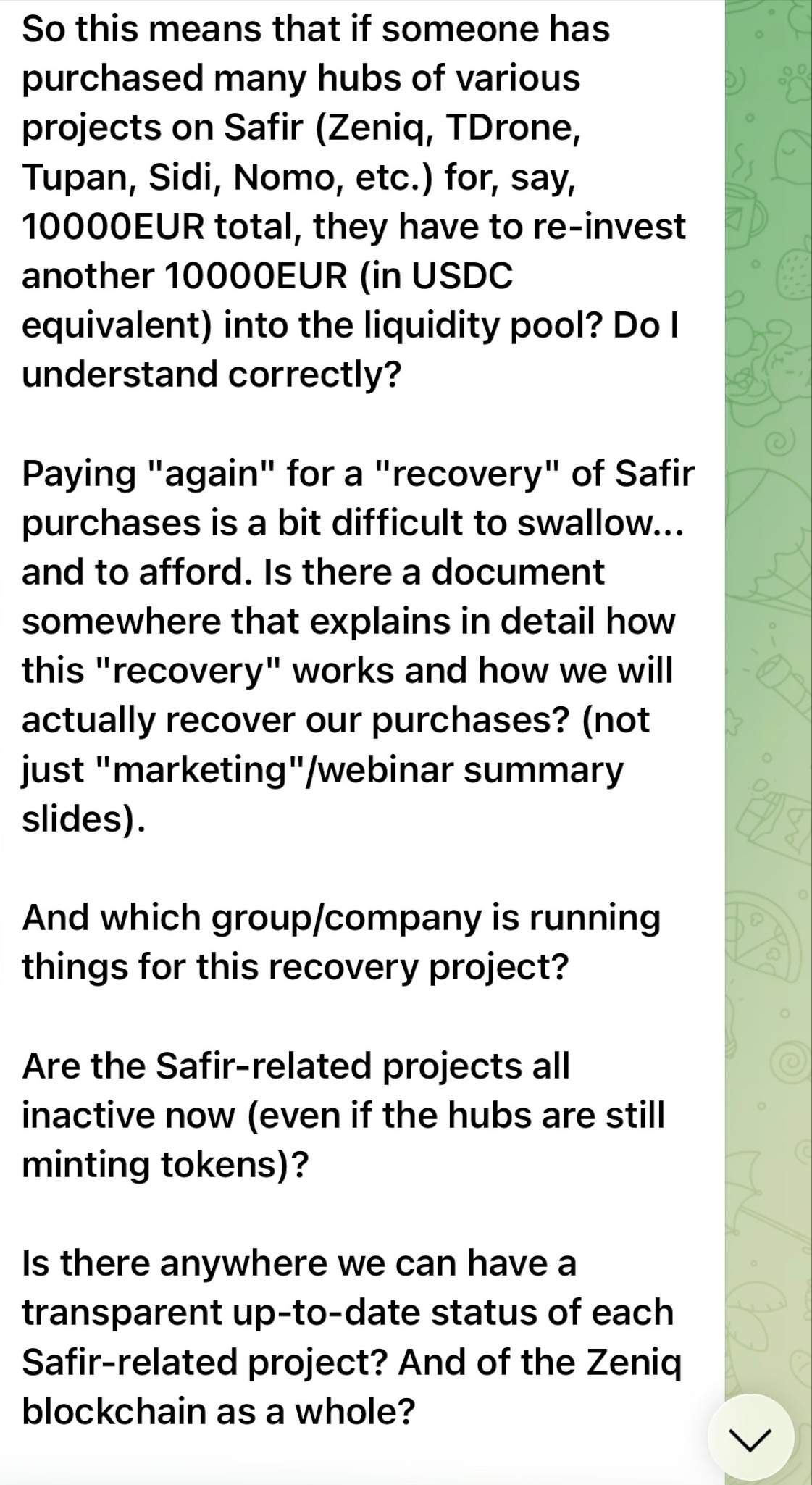
In a Telegram channel called ‘Support old Safir Community’, one member recently responded very tellingly to one of the initiators’ countless promotional videos:
“So that means that someone who has bought a lot of hubs from various projects at Safir (Zeniq, TDrone, Tupan, Sidi, Nomo, etc.) – let’s say for a total of EUR 10,000 – now has to reinvest another €10,000 (in USDC equivalent) into the liquidity pool? Have I understood that correctly?”
The channel operators’ response was telling: no clear answer, no official document – just vague references to other groups in the channel and information that had allegedly already been shared. What is evident here is not simply a communication problem. It is the basic principle of a system that constantly repaints itself but never really changes.
The basic pattern: pay twice to lose nothing
What this message thread reveals is the next stage of escalation in a familiar MLM scam: investors are supposed to ‘recover’ their already lost money – by investing again.
This is referred to internally as ‘recovery staking’ or ‘liquidity pool recovery’ and is sold in the chats as a ‘unique opportunity’ to ‘bring back’ former Safir-Zeniq Hub owners. But the supposed ‘recovery’ is in reality a reinvestment in a new, barely transparent project – this time on the platform connect.ac, the latest rebrand after Safir/Zeniq, Xera.Pro and XPRO.
So anyone who invested €10,000 in the infamous Zeniq hubs (hardware that was supposed to ‘mine’ tokens, but whose market value has long since imploded) is now expected to pay the same amount again to ‘get their old assets back’.
It’s like a fraudulent car dealer saying: Your engine is broken, but if you pay the full price for the same car again, you’ll get your old one replaced at some point.

From Safir/Zeniq to Xera.Pro to XPRO to connect.ac – the endless rebranding
The Telegram chat shows how confusing this network of companies and rebrands has become. The simple question ‘Who is actually running this?’ is almost impossible to answer, because:
Safir and Zeniq were the original platforms, marketed as blockchain innovations from Dubai. After regulatory pressure and increasing criticism, the brands were transferred to Xera.Pro and later XPRO Network. Under XPRO, a partner network was formed consisting of Homnifi, Shiiro, B2Pay and other ‘education’ or ‘finance’ providers. Since the end of 2025: the announcement of the closure of XPRO – and the new domain connect.ac, with almost the same team and marketing narrative.
This seamless chain, as we have already described in various articles here, is no coincidence. Every time the old structure falls into disrepute or investors lose confidence, a new name is presented. The old debts are rhetorically ‘closed’, while the same faces promote a new ‘opportunity’.
The psychology behind the system
What makes these MLM structures so effective is less about technology than psychology:
1. Hope for recovery – No one wants to admit total loss. The ‘recovery’ narrative offers emotional comfort: maybe something will come back after all.
2. Peer pressure and loyalty – Telegram chats and Zoom webinars are dominated by almost religious rhetoric. Anyone who expresses doubts is quickly labelled ‘negative’ or ‘unvisionary’.
3. Complexity as a tactic – tokens, hubs, staking, layer 2 bridges, NFT-backed assets – terms that suggest trust but which hardly anyone understands. This is how criticism is technically glossed over.
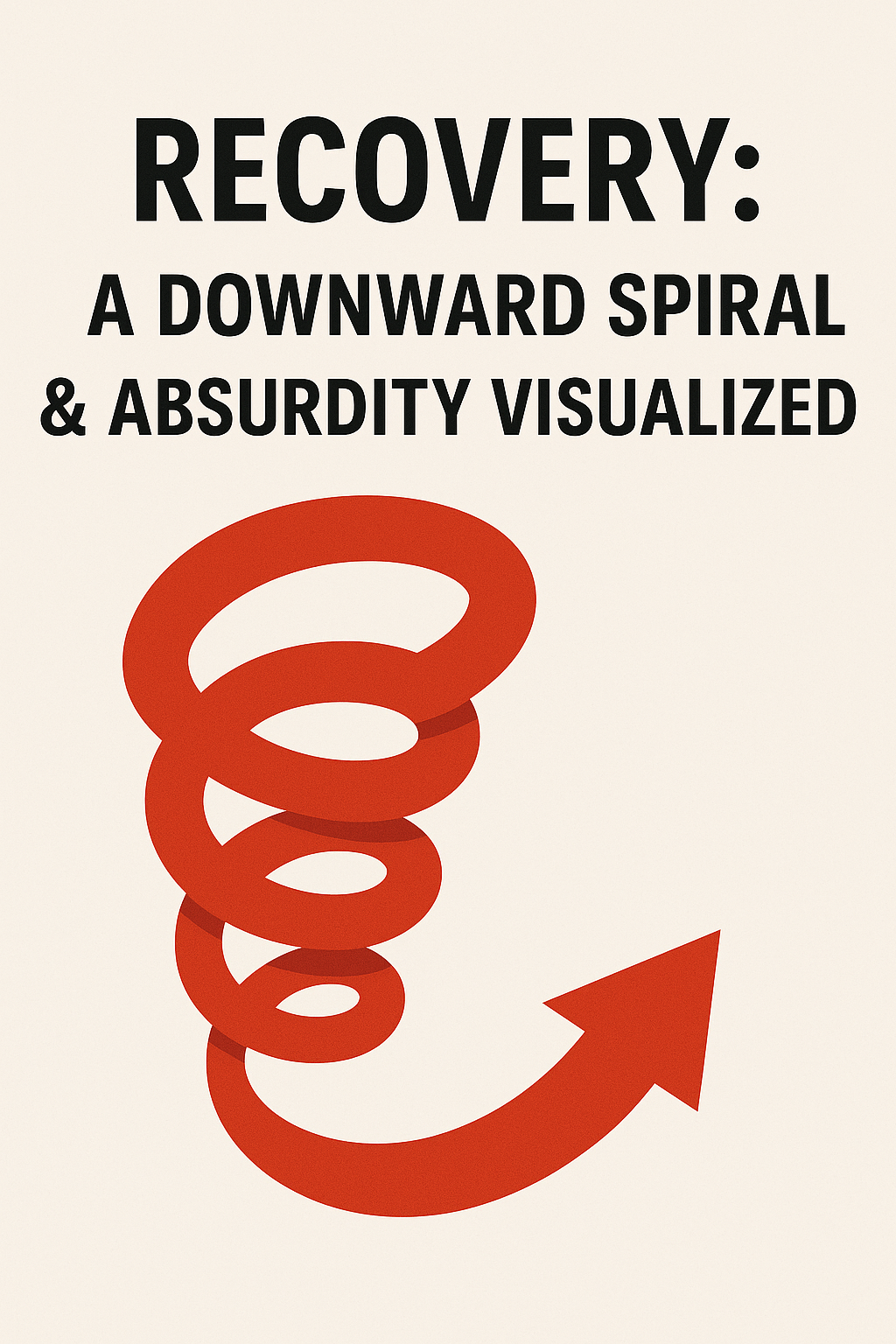
Recovery: A downward spiral & absurdity in numbers
If the information from the chat message quoted at the beginning is correct, this means that a Safir/Zeniq investor must pay at least the same amount again as part of a ‘recovery’ in order to have a chance of ‘restoration’ – without any guarantee, without proof of who is managing the money, and without a clear legal framework.
The question of ‘detailed documentation’ remained unanswered. Instead, the admins refer to marketing slides and chat groups that talk about ‘community support,’ ‘decentralisation,’ and ‘new tokenomics’ – all buzzwords that obscure the lack of substance.
In reality, ‘Recovery’ is a self-referential financial ecosystem that can only survive by constantly injecting new money. Old investors are fobbed off with new promises, new investors are recruited through FOMO (fear of missing out). When confidence wanes, the name is changed – and the cycle begins again. Rebranding replaces the exit.
Conclusion: The most expensive ‘recovery’ programme in the world
What is being sold as ‘recovery’ in the old Safir/Zeniq and the new connect.ac groups is in reality a second cash grab at the expense of the same people who already lost money in the previous projects. The system has no interest in transparency, only in continuity: On and on, always new names, always the same faces.
The desperate user in the chat who asked for a ‘document’ unwittingly sums up the whole tragedy:
‘I’m just trying to understand it all and catch up – but it’s impossible.’
He’s right. It’s not supposed to be understandable. Because confusion is part of the business model.
Note: This article is a journalistic analysis. It contains both verifiable facts (with sources) and assessments in the sense of expressions of opinion in accordance with Art. 5 GG / Art. 10 ECHR. All assessments are based on publicly available information and our own research (as of 29 September 2025). Affected companies have the opportunity to comment and issue counterstatements.
Sources: Chat groups Safir/Zenic/Connect


Leave a Reply
Want to join the discussion?Feel free to contribute!