

No banks, no system! The role of Austrian credit institutions in the Lyoness/Lyconet/myWorld complex
How credit institutions became the backbone of the insolvent Lyoness/myWorld system
We would like to take this opportunity to thank the whistleblowers for the numerous anonymous internal bank documents they provided us with. Thank you very much for your important cooperation!
The collapse of Lyoness/Lyconet/myWorld marks not only the end of a multi-level marketing model. However, the additional insights that have now been gained raise far greater questions: What role did banks play in allowing this system to operate for years – despite massive legal objections, ongoing investigations and thousands of aggrieved investors?
The answer is uncomfortable. Banks were not mere spectators. They became functional accomplices – not out of ideological affinity, but because they allowed themselves to be exploited.
No system without banks
Large-scale distribution and high-risk models such as Lyoness/Lyconet do not operate in a vacuum. They require a stable infrastructure:
- business accounts for central companies,
- smooth payment transactions for membership, licence and participation fees,
- the ability to pool, transfer and move funds,
- and banks that permanently support these processes.
It is precisely this infrastructure that several credit institutions have provided over many years. Without functioning bank connections, the system could neither have grown nor survived.

The documented proximity: banks at the centre of the payment flow
According to files, account statements, third-party debtor declarations and official documents, the following institutions in particular were involved in the processing of central payment flows:

UniCredit Bank Austria AG
Management of central business accounts of Lyoness Europe AG, processing of significant payment volumes and role as third-party debtor in numerous enforcement proceedings. At the latest since a seizure order by the Public Prosecutor’s Office for Economic Affairs and Corruption in 2014, there was objective knowledge of a criminal investigation.

Erste Bank / Sparkassen
Account management for individual companies affiliated with myWorld and regional payment processing.

Raiffeisen Banking Group
Selective involvement via regional institutions in the context of sales and payment transactions.

European American Investment Bank AG (in liquidation/insolvency proceedings since October 2024 following the FMA’s official prohibition of business operations)
Appearance in payment documents in connection with alternative and parallel structures outside Austria.
These institutions were not involved on the basis of rumours, but on the basis of concrete, documented payment flows.
Knowledge that could no longer be ignored
The instrumentalisation of the banks was made possible by the fact that they continued to operate despite a body of knowledge that had been growing for years:
- Numerous legally binding judgements in civil and competition law that classified central elements of the business model as unethical or misleading.
- Criminal investigations and seizure orders that were formally known to the banks.
- An inflationary enforcement situation, visible in a large number of seizures and third-party debtor declarations.
- Ongoing media warnings that coincided with court findings.
- A highly conspicuous payment profile from a banking perspective: thousands of depositors, standardised amounts, hardly any real consideration, rapid outflow of funds.
Each of these points would have required increased attention on its own. Taken together, they made the claim of continued neutrality appear no longer credible.
Neutrality under banking law is not a permanent safe haven. It ends where credit institutions obtain reliable knowledge of significant legal and systemic risks, where their own services are functionally necessary for the continuation of a potentially harmful business model, and where inaction objectively contributes to prolonging or deepening the damage. In the Lyoness/myWorld complex, this point was reached long before formal insolvency. From that point on, it was no longer possible to speak of mere neutrality.
At the latest when this information became available, banks would have been obliged to materially reassess the business model, restrict or interrupt payment flows, carry out enhanced AML and KYC checks, and ensure that the accounts were used for their intended purpose. If the risks persisted, this would have had to lead to the termination of the business relationship and, if necessary, to the competent supervisory authorities being informed. None of these measures requires a criminal conviction. It is not guilt that is decisive, but knowledge.
The structural failure
The Lyoness case reveals a pattern that goes beyond this individual case:
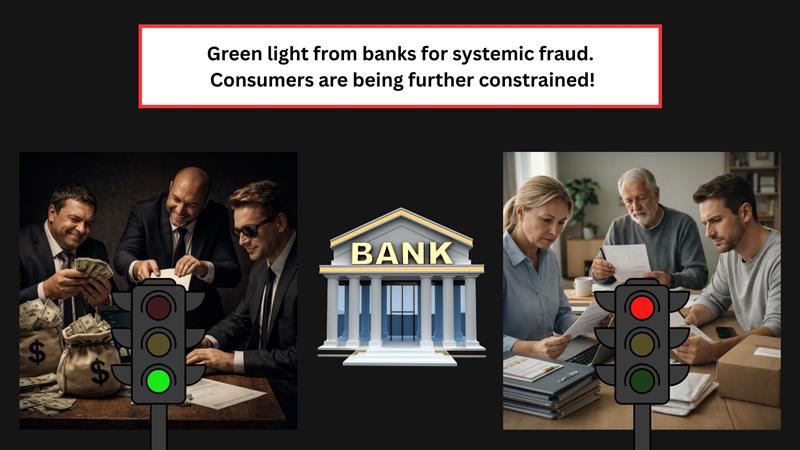
Banks act cautiously where systemic risks threaten and liability is at stake – and rigorously where individual customers have little means of defence.
In this way, credit institutions become private centres of power that decide on solvency and economic existence without comparable transparency and justification requirements as government agencies.
Conclusion
Banks were not perpetrators in the Lyoness/myWorld complex.
But they were not neutral conduits either.
They allowed themselves to be instrumentalised – as infrastructure, as an anchor of trust, as silent enablers.
And that is precisely where the real failure lies.
Because without banks, this system would not have survived.
Note:
This article is a journalistic analysis. It is based on publicly available sources. It is not a legal assessment or financial advice. All assessments have been researched to the best of our knowledge and are marked as opinions within the meaning of Art. 10 ECHR / Art. 5 GG. Counterstatements will be considered in accordance with § 56 RStV.
Sources:
- Supreme Court (Austria) – Decisions on Lyoness (including 4 Ob 71/12i, 4 Ob 47/14g, 4 Ob 93/15b), available via the Federal Legal Information System.
- Munich Regional Court I – competition law decisions on Lyoness, available at https://openjur.de
- Public Prosecutor’s Office for Economic Affairs and Corruption (WKStA) – preliminary investigations and seizure measures in the Lyoness/myWorld environment, documented, among other things, by media reports in Der Standard, profil and Falter
- Commercial register / enforcement register (Austria) – seizures, third-party debtor declarations and enforcement proceedings against Lyoness/myWorld companies,
- Austrian Financial Market Authority (FMA) – prohibition of business operations of European American Investment Bank AG (EURAM Bank), October 2024,
- Insolvency file / Deposit Protection Austria – Insolvency proceedings EURAM Bank,
- EU legal sources – Money laundering prevention and banking obligations (AMLD, EBA Guidelines),
- Own research – Evaluation of anonymised internal bank documents, payment receipts, account statements and third-party debtor declarations (editorially reviewed, archived)

Leave a Reply
Want to join the discussion?Feel free to contribute!