
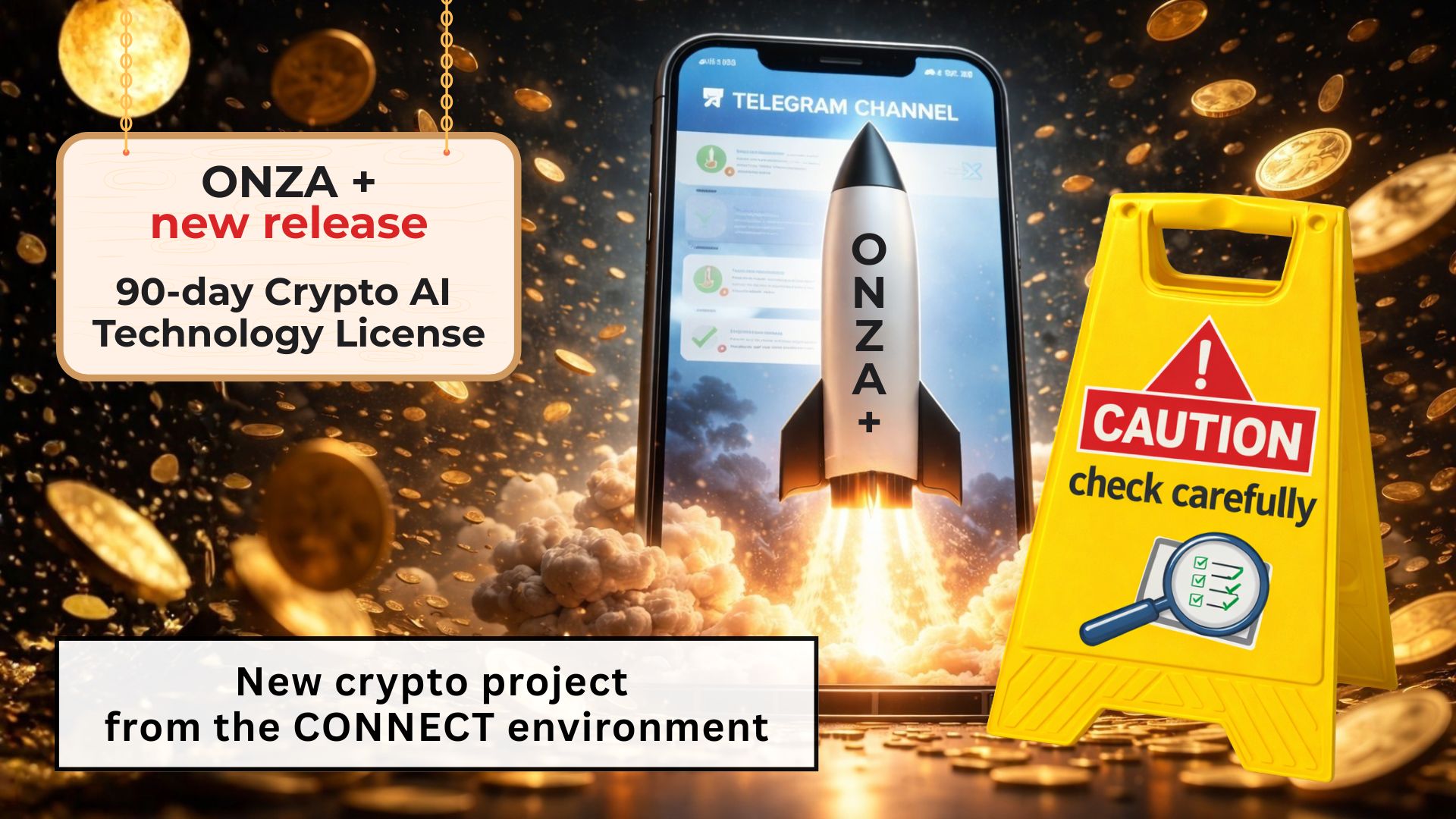
ONZA+: CONNECT’s AI Promise
How a new crypto project from the CONNECT ecosystem is attracting participants with AI, trading signals, and a license-based model.
Within the Telegram community surrounding CONNECT (formerly Safir/ZENIQ/Xera.Pro/XPRO), a new project called ONZA+ has been circulating for several weeks. The product is promoted as a “90-day Crypto AI Technology License” – essentially a time-limited license that supposedly grants access to an AI-powered trading infrastructure.
At the same time, the material repeatedly emphasizes that ONZA+ is neither an investment nor a financial service – a combination that inevitably raises questions. The presentation available to us promises algorithmic cryptocurrency trading, automated market analysis and potential profits within a 90-day cycle.
The internal starting signal
In a message addressed to “Regional Directors and CONNECT Top Leaders,” the company announced the launch of the project:
“We would like to officially inform you about the launch of ONZA, the new crypto service that will begin its integration into the CONNECT ecosystem starting March 1st.”
As a first step, an official ONZA+ Telegram channel was launched through which users are expected to receive free crypto trading signals. According to the message, the channel offers free crypto signals, the possibility for users to manually copy those signals, and serves as the main entry point into the ONZA ecosystem.
The message explicitly encourages leaders to distribute the channel within their teams and leadership structures. This makes it clear that the Telegram channel is not merely an information platform but part of a structured recruitment strategy designed to expand the network.
Leadership from the CONNECT ecosystem
The same message also identifies the person leading the project:
“The ONZA project is led by Luis Fernando Key, whom many of you already know as the International Director of Crypto Expansion at CONNECT.”

The project is therefore directly linked to the existing CONNECT structure and presented as part of a new “crypto vertical” within the ecosystem.
At the same time, an external trading partner is mentioned: the cryptocurrency exchange Bitunix. Users are encouraged to create so-called “corporate accounts” on that platform. According to the announcement, these accounts will be used for signal distribution, optimized trading operations, future copy-trading services and access to certain advantages for the community. In practice, the Telegram channel functions as both a marketing funnel and a gateway through which users can gradually be introduced to additional products within the system.
The product: an “AI license”
The actual business model is described in the ONZA+ presentation. Participants purchase a license with a duration of
90 days. During this period the invested capital is allegedly deployed within what the document calls a “proprietary AI infrastructure.”

Five license tiers are offered, ranging from 125 to 5,000 dollars.
According to the presentation, the higher the license level, the higher the potential “rewards.” Possible returns mentioned in the document range from 300 to 15,000 dollars.
At the same time, the presentation repeatedly states: “ONZA+ is not an investment or financial service.” This legal distancing stands in clear contrast to the profit scenarios presented in the material.
Capital lock-up and a black box
According to the presentation, the system works in a straightforward way. Users purchase a license and their capital is locked for a period of 90 days.
During that time an AI system supposedly trades automatically on cryptocurrency markets. After the cycle ends, the capital becomes available again.
Withdrawals are not possible during the active period. What exactly happens during those three months remains largely unclear. The presentation refers to market scanning, algorithmic execution, high-frequency strategies and automated risk-control systems, yet it provides no technical details that would allow these claims to be independently verified.
Important questions therefore remain unanswered. The presentation does not specify which exchanges are used for trading, where customer funds are actually held, whether independent audits exist or whether any regulated asset-management structure is involved. As a result, the AI infrastructure described in the document effectively remains a complete black box.
Return scenarios of up to 60 percent
Particularly striking are the performance ranges described in the presentation. Three trading modes are outlined. A conservative mode is said to produce returns of eight to fifteen percent, a balanced mode between twelve and thirty percent, and an aggressive mode between twenty and sixty percent.

For a period of only ninety days such returns would be extraordinary even in the highly volatile cryptocurrency markets. In regulated financial environments, claims of this nature would typically require detailed risk disclosures and verifiable
historical performance data. The ONZA presentation, however, does not provide such evidence.
The recruitment structure
Another central component of the model is a referral system. Participants can receive commissions when they recruit new users. According to the presentation, the system extends across three levels and rewards network growth within the structure.

To illustrate the concept, the document presents an example scenario. One participant recruits five new members. Each of those participants then recruits five more, and the process continues once again on the next level. By the third level, the network would consist of 125 additional participants. The potential earnings from such a structure are illustrated with figures reaching into the five-digit range.
Models based on exponential recruitment are characteristic of multi-level marketing structures. They rely heavily on continuous growth and the steady influx of new participants. Without that growth, such systems tend to lose momentum quickly.
Compliance without oversight
The presentation refers to concepts such as KYC verification, cybersecurity and future improvements in compliance structures. At the same time, the terms indicate that regulatory responsibility lies with the user.
Equally noteworthy is what the document does not contain. There is no clearly identified operating company, no visible financial license, no named regulatory authority and no independent audit documentation. For a system that claims to operate automated trading strategies with user capital, these omissions represent significant transparency gaps.
Conclusion
The documents surrounding ONZA outline a clear strategy. A free Telegram channel distributes trading signals and introduces users to a broader ecosystem. From there, participants are encouraged to purchase a paid 90-day “AI license,” while a referral structure incentivizes network expansion.
The project is marketed using terms such as AI trading, algorithmic strategies and automated market analysis. Yet the fundamental information required to verify these claims is missing.
Whether ONZA actually operates a functional AI trading infrastructure or whether the concept primarily serves as a marketing narrative cannot be determined based on the available material.
What can be said with certainty is that when a project combines high return promises, limited transparency and a strong recruitment component, potential participants would be wise to approach it with caution.
Note:
This article is a journalistic analysis. It is based on publicly available sources. It is not a legal assessment or financial advice. All assessments have been researched to the best of our knowledge and are marked as opinions within the meaning of Art. 10 ECHR / Art. 5 GG. Counterstatements will be taken into account in accordance with § 56 RStV.
Sources
- Connect, ONZA Telegram Groups
- Own Verification (Editorial Team)


Leave a Reply
Want to join the discussion?Feel free to contribute!