
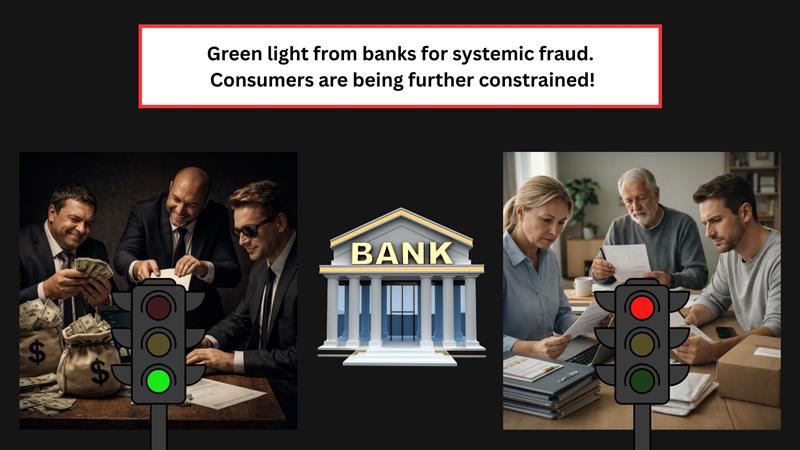
Neutral when it comes to fraud, merciless when it comes to customers – the double failure of banks
How credit institutions enable fraud and expropriate innocent people at the same time
‘Which is the greater crime, robbing a bank or founding one?’
Today, Brecht’s famous question seems less provocative than sobering. What is increasingly evident in the European banking sector is no longer an isolated case, but a structural failure.
Banks are acting illegally in two ways:
– too passively where they should be acting,
– too aggressively where they should be holding back.
Both follow the same logic.
When banks keep fraud alive
The Lyoness / Lyconet / myWorld complex is not a marginal phenomenon, but one of the best-documented cases of multi-level marketing and pyramid schemes in the German-speaking world.
For years, courts have criticised key aspects of the business model, often classifying it as unethical and illegal. The number of legally binding decisions is considerable.
And yet accounts remained open, payment flows continued, and participation and licence fees continued to be processed.
According to the case law of the Federal Court of Justice, neutrality ends where there is reliable knowledge. Legally binding judgements no longer allow for ‘ignorance’. Anyone who continues to maintain accounts and thus provides the functionally necessary infrastructure is no longer acting neutrally.
Banks are failing in this regard through omission.

When banks become judges and enforcers
While banks turn a blind eye to systemic fraud for years, they act with remarkable harshness in other areas:
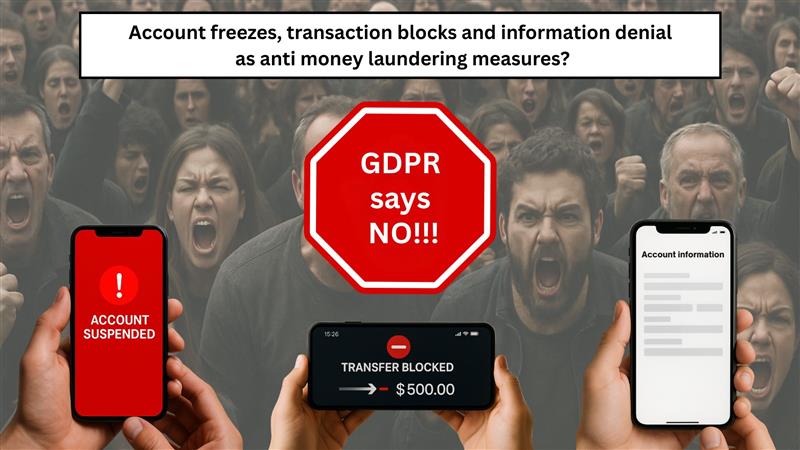
– Account closures without warning,
– Transfer blocks without justification,
– Terminations with a blanket reference to ‘compliance’ or ‘AML’.
Small businesses, the self-employed and inconspicuous payees are often affected. Decisions are made internally, often with the help of AI, without any discernible case-by-case review. The consequences are existential – accompanied by silence.
Refusal of transparency as a business model
Banks reflexively invoke banking secrecy, internal risk models or money laundering prevention.
But this argument falls short.
The European Court of Justice has made it clear:
Risk assessments, scores and classifications are personal data. The right to information under Art. 15 GDPR also covers them in the AML context.
Banks are allowed to investigate, block and terminate.
However, they are not allowed to remain silent if their assessments damage reputations and have economic consequences.
A blanket refusal to provide information violates European data protection law.
Selective neutrality
Both phenomena appear to be contradictory, but they are two sides of the same coin:
Case
Fraud established by the court
Unremarkable customer
Bank behaviour
‘We are neutral’
‘Compliance – no information’
Neutrality is claimed where liability is a threat.
Power is exercised where those affected have little means of defence.
Banks as private sovereign entities
In fact, banks perform tasks with quasi-sovereign effect:
– they decide on solvency,
– deprive market participants of their economic basis,
– classify individuals and companies as ‘risky’.
Unlike public authorities, however, they are not subject to obligations to disclose files or to provide effective justification. This creates a constitutional vacuum in which private actors exercise power without corresponding obligations.
Conclusion: a dangerous imbalance
As long as banks
– hide behind neutrality where judgements have been made,
– and entrench themselves behind compliance where transparency obligations apply,
risk management degenerates into a technique of power.
The crucial question is no longer whether this system is illegal, but why supervisory authorities, politicians and the judiciary allow private institutions to exercise more power than state authorities – without their obligations.
This is not an operational problem.
It is a democratic one.
Note:
This article is a journalistic analysis. It separates facts, legal standards and opinion. It does not constitute legal advice in individual cases. Protection under Art. 5 GG / Art. 10 ECHR. Counterstatements are expressly welcome.
Sources:
· Federal Court of Justice (BGH) case law
Liability and limits of neutrality of payment service providers with secure knowledge of illegal business models
(including BGH, III ZR 299/08; III ZR 296/15)
· Court decisions on Lyoness / myWorld
Several legally binding judgements in Germany and Austria with objections on the grounds of immorality and misleading practices
· ECJ – Right to information & scoring
Risk assessments and profiling are personal data within the meaning of Art. 15 GDPR
(ECJ, C-634/21 – SCHUFA)
· General Data Protection Regulation (GDPR)
Articles 4, 15 and 22 GDPR – Rights of access and automated decisions
· EBA / FATF guidelines
Risk-based approach to money laundering prevention, obligations of credit institutions
· Fundamental and media rights
Article 5 of the German Basic Law, Article 10 of the ECHR – Protection of journalistic analysis and freedom of expression

Leave a Reply
Want to join the discussion?Feel free to contribute!