

VOW tokens: Price rise despite lack of substance – where is the money really going?
Where is the money going – and why the price rise is no proof of substance.
The crypto project VOW presents itself as a beacon of technological hope: blockchain-based, transparent, decentralised – at least, that is the official self-image. But a look at its actual activity raises doubts. Although, according to the project, numerous customers and partner companies use the system, hardly any transactions can be traced on the blockchain. In the crypto sector, a simple rule applies: real use leaves traces.
Token movements, smart contract interactions and wallet activity are all largely absent in the case of VOW. The platform, which positions itself as a blockchain company, appears to be using the technology more as a marketing tool than as a technical foundation.
VOW is currently listed on only a few, partly barely regulated trading platforms, such as Coinsbit, Azbit or on smaller DeFi exchanges with low liquidity. In such markets, even small trading movements can lead to significant price fluctuations.


Where is the money going?
Observers are particularly critical of the project’s internal financial structures: according to internal presentations, funds are collected from investors via constructs such as The Last Network (TLN) and so-called liquidity pools – officially to finance the ecosystem.
However, according to former participants and industry analysts, considerable funds have flowed to individuals associated with the project. Among those named in this context are Bishara ‘Bish’ Smeir, who is considered the founder and strategic mind behind VOW, and Jörg Wittke, who emerged as a leading promoter in German-speaking countries.
Critics accuse the project of investing a significant portion of the funds not in the further development of blockchain technology, but in traditional companies outside the decentralised sector, i.e. in so-called Web2 structures. An independent review of these allegations is not yet available.
Who are Bish and Wittke?
Bishara ‘Bish’ Smeir comes from the cashback and affiliate marketing sector and first appeared with projects such as ‘CashbackApp’.
According to publicly available sources, Jörg Wittke was previously active in several multi-level marketing programmes, including BitClub Network, Jubilee Ace and HyperFund – all models that have been criticised or discontinued.
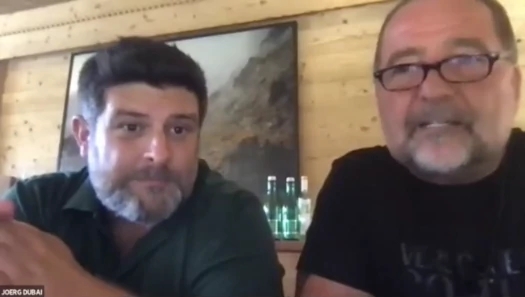
Three key points of criticism from the community:
- Structural interdependencies: TLN is said to have acted as a distribution structure for acquiring new investors. According to some observers, returns did not flow back into the project, but primarily to individual players.
- Criticism of the distribution logic: According to former participants, payments to participants were primarily fed by new deposits – a pattern that has been observed in the past in pyramid or Ponzi-like structures. Whether this is relevant under criminal law in this specific case remains open.
- Responsibility for the price collapse: The review platform Trustpilot reports that Jörg Wittke is said to have triggered a price collapse by selling large quantities of VOW tokens. There is no official confirmation of this.

Price increase without fundamentals
The recent price increase of the VOW token coincides with an exchange offer to alleged shareholders of myWorld International AG. They were advised to convert their holdings into VOW tokens. Observers believe that this created artificial demand, as many investors did not purchase the tokens voluntarily but accepted them as part of the structure.
In illiquid markets, even low buying pressure can trigger significant price movements. Furthermore, it remains unclear whether internal project wallets were used specifically to stabilise the price. Such practices have been documented in other projects but cannot be proven beyond doubt in this case.
Conclusion
The VOW project is viewed critically by parts of the crypto community: the lack of transparent blockchain activity, the close links to a distribution structure (TLN), questionable token distribution and a price increase that is likely based less on trust than on internal mechanisms give cause for scepticism.
Whether VOW is an innovative technology project or a structurally packaged financial product ultimately remains open. One thing is certain: a rising price alone is no proof of substance. And where the money really goes remains one of the central questions.
Note: This article is intended solely for informational purposes, journalistic analysis and independent opinion-forming within the meaning of Article 5 of the German Basic Law and Section 51 of the German Copyright Act (UrhG) (right to quote). All information is based on publicly available sources, official communications and careful editorial research. Despite the utmost care taken, we cannot guarantee the accuracy, completeness or timeliness of the information contained herein.
Sources:
This document contains a compilation of sources and evidence relating to the VOW crypto project and the associated structure The Last Network (TLN).
The information is provided for the purposes of media law compliance and to substantiate the content.
CertiK: Vow Incident Analysis (August 2024)
URL: https://www.certik.com/resources/blog/vow-incident-analysis
Crypto.news: Vow suffered ~$1.2m exploit, token plunged 80%
URL: https://crypto.news/certik-vow-suffered-1-2m-exploit-token-plunged-80/
Blocktrainer Forum: Discussion about VOW/TLN
URL: https://forum.blocktrainer.de/t/vow-wer-kann-etwas-dazu-sagen/30691
Trustpilot: User reviews of VOW
URL: https://www.trustpilot.com/review/www.vowcurrency.com


Leave a Reply
Want to join the discussion?Feel free to contribute!