
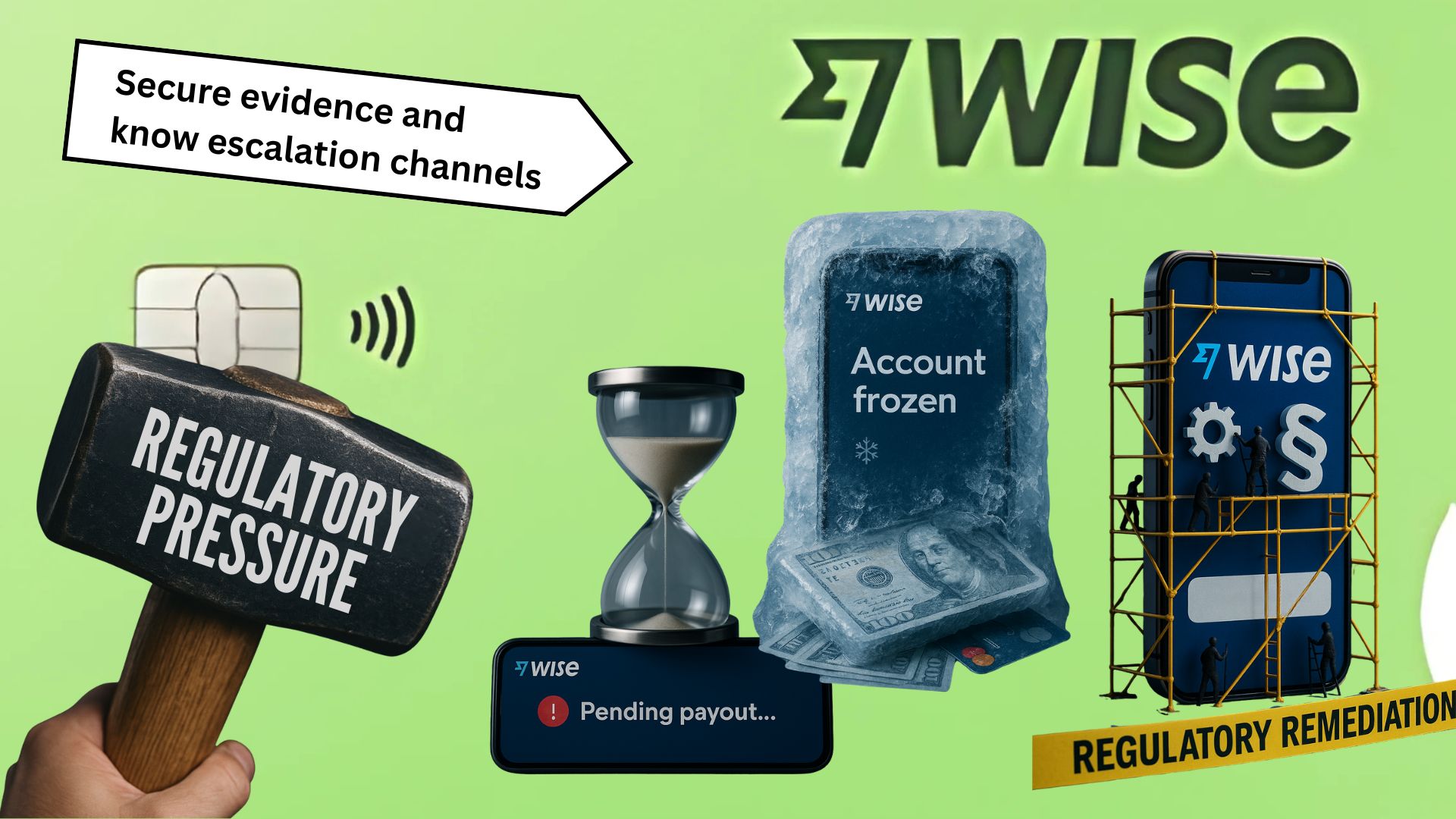
WISE under pressure: account closures, retained credit balances and regulatory requirements – what users need to know now
On request: legal DE/EN template for complaints to WISE (Legal) – including facts, transaction/file number, deadline and references to Ombudsfin, NBB/NCA, CFPB/State Regulators; individually customisable. ( [email protected] )
Since the end of 2024, there have been increasing reports of account freezes, closures and delayed payments at WISE (formerly TransferWise). At the same time, EU and US regulators are forcing the fintech company to implement comprehensive remediation measures. This explains many of the current complaints, but does not automatically resolve them.
What the regulators are demanding – and why this affects users
- Europe (NBB/Belgium): According to the Financial Times, WISE was forced into a formal remediation plan by the National Bank of Belgium at the end of 2024, partly due to a large-scale lack of proof of address. The result: widespread additional requests for proof of address within weeks and freezes for non-compliance. This explains the EU-wide suspensions reported in 2025.
- USA (multi-state settlement, 9 July 2025): WISE US Inc. is paying $4.2 million and must implement, among other things, lookbacks for closed accounts, SAR follow-ups and stricter AML controls. In practical terms, this means more checks, temporary holds and closures – even in cases where users are not informed of the reasons.

Official WISE process for closures & checks
In its Help Centre, WISE points out that customers can withdraw their credit balances before the final closure; however, subsequent checks may still be pending. WISE typically states that ‘additional checks’ take 2–10 working days, occasionally longer. In practice, some customers report significantly longer processes.

Better Business Bureau
The 5 most recent cases (summer 2025) – documented by the BBB
Excerpts from five current complaints to the Better Business Bureau about WISE US; they show the range of problems and responses (data/status taken from BBB entries):
- 19 August 2025 – Account blocked after first salary payment, customer had to arrange refund; confirmed as ‘resolved’ on 9 September 2025.
- 11 August 2025 – Business account closed, no response received; WISE referred to the competent EU arbitration body (Ombudsfin) and offered a goodwill gesture of USD 30.
- 23 July 2025 – Unauthorised card transactions disputed, followed by account closure; WISE cited regulatory reasons and referred to the help centre process for repayment.
- 11 July 2025 – Account closed without explanation, WISE only cites terms and conditions of use; response listed as ‘answered’.
- 18 June 2025 – Business account closed, ~$4,000 initially retained; WISE refers to due diligence checks (≈ 60 working days) – Refund on 4 July 2025 documented.
Classification: The cases are isolated incidents, but show a consistent pattern: (1) closure/freeze, (2) sparse justification, (3) audit-related retention, (4) sometimes delayed communication, (5) repayment after completion of the audits – or referral to competent arbitration bodies. The patterns are consistent with EU remediation pressure and the US consent order.
What those affected can do specifically
- Secure evidence & submit a formal complaint to WISE (ticket, correspondence, account statements). The process and reimbursement steps are described in the Help Centre.
- EU/EEA: After receiving a final response from WISE, escalate to Ombudsfin (Belgium, responsible for Wise Europe SA) if necessary; at the same time, involve national financial supervision/consumer arbitration if necessary. (The BBB also refers to this in EU cases.)
- USA: Complaint to State Regulators/NY DFS/DFPI or CFPB; the Consent Order PDF and the NY DFS press release are useful as leverage.

- Legal template: Upon request, we will provide a sample legal template (DE/EN) that you can send directly to WISE (Complaints/Legal). The template includes, among other things, a statement of facts, file numbers/transactions, deadlines and references to the relevant supervisory and arbitration bodies (Ombudsfin, NBB/NCA, CFPB/State Regulators) and can be adapted to your case.
Conclusion
WISE finds itself between regulatory pressure and the reality of scaling: The remediation obligations (EU) and the multistate settlement (US) increase internal risk sensitivity – with noticeable side effects for end customers. Those affected should provide evidence at an early stage, meet deadlines and be aware of escalation channels. The documented cases show that repayments are possible – but require time, evidence and persistence.
Note:
This article is based on publicly available sources, documented complaints from investors and an official press enquiry. It is a journalistic analysis. All statements about legal risks or possible contractual constellations are to be understood as assessments, not as conclusive legal advice. Those affected should seek legal advice in case of doubt.
Sources
- Financial Times: NBB forces WISE into remediation plan (29 November 2024). Financial Times
- Reuters: Report on European remediation plan (29 November 2024). Reuters
- NY DFS (press release): Multistate settlement & $4.2 million (9 July 2025). Department of Financial Services
- DFPI (original PDF): Consent Order Wise US Inc. (9 July 2025). DFPI
- Payments Dive / American Banker: Context reports on the settlement (July 2025). paymentsdive.com+1
- Wise Help Centre: ‘My account is being closed’, ‘Additional checks’. Wise+1
- BBB Complaints (Summer 2025): Case studies & WISE responses.

Leave a Reply
Want to join the discussion?Feel free to contribute!