
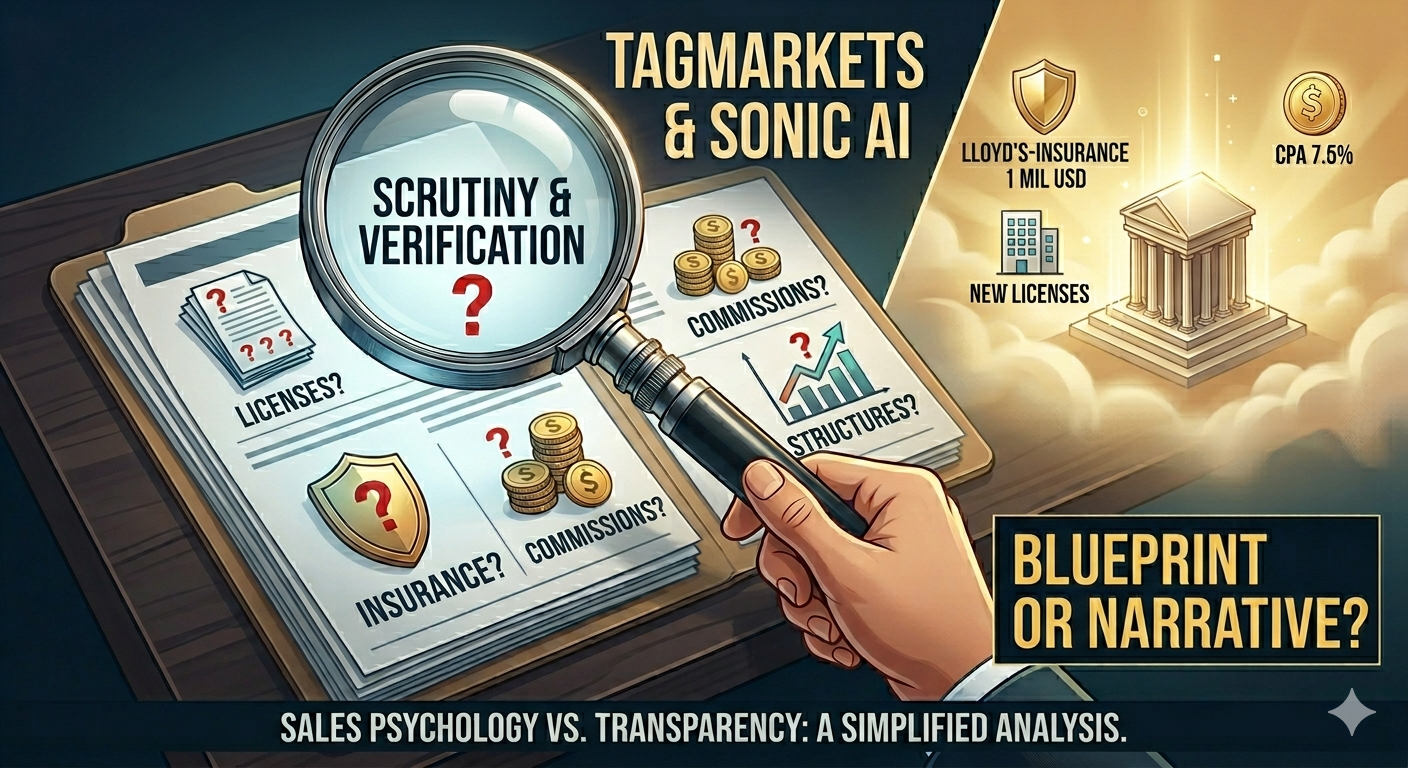
TAGMarkets Updates: Glossy Promises & Familiar Patterns
At first glance, the content presented in a recent TAGMarkets update—specifically the expanded ecosystem comprising the broker, Sonic AI, and sales operations—reads like the blueprint for a rapidly growing FinTech company: higher CPA commission tiers, new broker licenses, alleged Lloyd’s insurance coverage of up to one million US dollars per account, and strategic liquidity adjustments for risk control.
From our perspective, however, such statements should not be interpreted as reliable evidence of substance, but rather as classic sales psychology narratives aimed at distribution. These patterns have been well-known for years within commission-driven MLM, crypto, and offshore broker models.
Higher CPA Commissions: Sales Over Product?
Particularly striking is the strong emphasis on new CPA (Cost Per Acquisition) levels ranging from 7 to 7.5 percent. While regulated financial service providers generally focus their communication on product quality, regulatory security, and client performance, the focus here is once again on monetization for sales partners. This indicates that the system’s growth is intended to primarily occur through recruitment and sales activity—a typical characteristic of commission-driven network models.

New Licenses: Regulation or Marketing Tool?
The announcement of a South African broker license, along with further approvals expected within 90 days, initially sounds like regulatory expansion. However, the decisive factors are the specific rights this license actually entails, which authority issued it, and whether it holds any relevance for European investors.
Offshore or third-country licenses are frequently marketed in sales as seals of quality, even though they do not offer nearly the same scope of protection as established EU regulations, such as those from BaFin, FCA, or CySEC. Without independent verification, such a license remains primarily a marketing argument.
Lloyd’s Insurance: Reality or Trust Narrative?
The claim that client funds are insured through Lloyd’s of London for up to one million dollars would be a significant security factor—provided it is fully and verifiably accurate. Precisely for this reason, such statements absolutely require verifiable documentation.
Critical details would include, among other things, the full name of the insurer, a policy number, the scope of coverage, as well as exclusions and details regarding legal enforceability for international clients. Without publicly verifiable insurance documents, this promise also remains primarily a strong sales narrative designed specifically to create trust.
Liquidity Adjustment and Risk Management: Complexity as a Lever for Trust
The discussion surrounding 24x or 12x liquidity models conveys an image of technological and mathematical professionalism. However, in sales, such complex-sounding terms can also serve to simulate credibility without requiring investors to understand the actual mechanisms.
Without transparent disclosure of real trading structures, liquidity providers, audit data, or track records, it remains unclear whether these statements represent operational reality or primarily a presentation strategy.
Conclusion: TAGMarkets Updates – A Familiar Pattern in New Clothing
The communication follows a schema well-known from previous high-risk and network projects: higher commission incentives, international expansion, regulatory narratives, emphatic security promises, suggested technological progress, and a sense of urgency (“Those who act now…”). Precisely the combination of a sales focus, FOMO (Fear Of Missing Out) rhetoric, and difficult-to-verify security promises should prompt investors to exercise particular caution.
Not every ambitious project is automatically dubious. However, when sales, community growth, and recruitment are emphasized more strongly than transparent regulation, independent auditing, and a verifiable financial structure, this corresponds to a pattern that investigative observers have recognized for years across numerous controversial systems.
Note
This article presents a journalistic analysis.
It is based on publicly available sources as well as original research and distinguishes between facts, assessments, and opinions . The evaluations of external sources reflect their respective assessments. No final legal or criminal assessment is made. Publication is in accordance with the freedom of the press guaranteed by Article 5 of the German Basic Law and Article 10 of the European Convention on Human Rights.
Sources
- Publicly available profiles of the referenced projects (including Youtube, Facebook, Telegram channels/ groups); research status: April 2026
- Independent editorial analysis of webinars, marketing materials, and investor reports

Leave a Reply
Want to join the discussion?Feel free to contribute!