
Myw Portugal insolvent: The quota is theory – the assignment is strategy
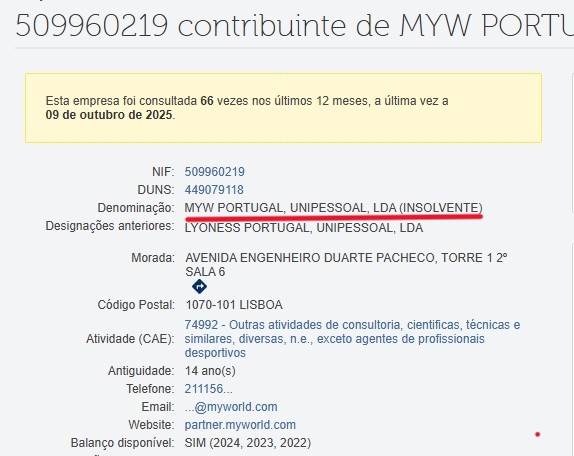
In a ruling by the Lisbon Commercial Court (Ref.: 22852/25.1T8LSB) on 28 September 2025, Myw Portugal, Unipessoal, Lda., a national subsidiary of the international myWorld Group, was officially declared insolvent. For Portuguese victims, the crucial question now is: Does it make sense to file individual claims in the insolvency proceedings, or should claims be bundled outside the proceedings and asserted against the responsible decision-makers or parent structures?
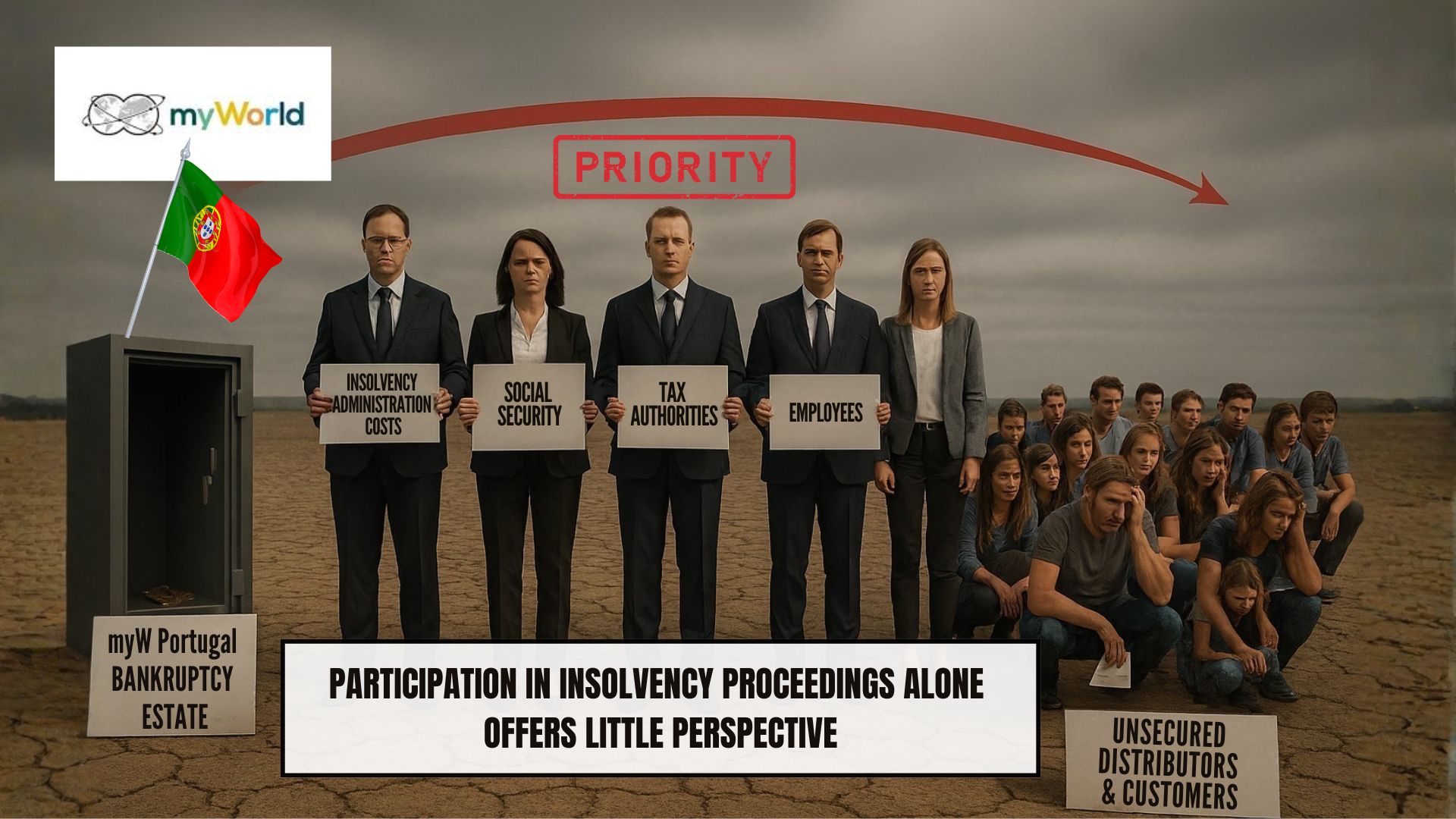
Small estate – high priorities of other creditors
Initial registry information indicates that the company’s share capital is estimated to be in the region of €25,000. Whether there are any substantial assets beyond this has not yet been disclosed. In comparable sales structures, it has often been found that national companies primarily fulfilled operational roles, while cash flows were passed on within the group.
If the insolvency proceedings result in a settlement, the costs of the insolvency proceedings and privileged claims, for example from social security, tax authorities or employees, take precedence. In such constellations, unsecured creditors often receive only a small or no dividend.
Individual registration in insolvency proceedings: formally necessary, but often of little practical use
Claims must be filed via the digital court portal within 30 days in order to be considered at all. However, this only secures a formal procedural position, not an economically relevant prospect of compensation. Those who rely exclusively on the quota may find themselves in proceedings with minimal distribution and no influence on further levels of liability.
Thinking beyond the insolvency proceedings: examining personal and group-wide liability
The key issue may not be the national subsidiary itself, but whether there are any additional responsibilities. Possible grounds for liability, the validity of which has yet to be examined, include:
- breaches of duty by local decision-makers,
- possible group liability in the case of economic control by the parent company,
- tort claims in the case of intentional damage to distribution partners or customers,
- delayed insolvency filing,
- possible asset transfers in favour of individual parties involved.
Multinational structures in particular often show that economically relevant decisions were made outside the national company and assets were not held locally.
Why an assignment procedure makes strategic sense
In order to pursue such claims effectively, injured parties are increasingly joining forces in an assignment model. In doing so, they assign their claims in whole or in part to a specialised institution, which enforces them collectively. Those affected remain economically involved, but hand over the legal enforcement to professional claim managers.
A joint assignment procedure can offer several advantages:
✅ Stronger negotiating position through bundling
✅ Possibility to take direct action against liable persons or parent structures beyond the insolvency proceedings
✅ Access to evidence from parallel group insolvencies
✅ Use of findings on possible enrichment structures
✅ Elimination of individual litigation costs (depending on the model, success-based)
✅ Simplified cross-border enforcement of claims under EU law (Brussels Ia Regulation)
The parallel insolvencies of other group entities are increasingly bringing to light documents that point to economic shifts within a clearly defined group of individuals. This facilitates the presentation of evidence in recovery claims, provided that these are bundled and pursued specifically against those responsible for liability.
Conclusion: Participation in insolvency proceedings alone offers little prospect of success – collective enforcement can be more effective
For many of those affected, the Myw Portugal insolvency is likely to be only a formal entry point rather than the actual goal. Those who merely file their claims but do not get further involved risk coming away empty-handed in the end. In contrast, a bundled assignment offers the opportunity to be more than just a pro rata creditor of a potentially empty shell, but to become an active part of a liability review at the group or decision-maker level.
Note:
This article is based on publicly available sources, documented complaints from investors and an official press enquiry to Blocktrade. It is a journalistic analysis. All statements about legal risks or possible contractual constellations are to be understood as assessments, not as conclusive legal advice.
Sources:
· Company register entry Myw Portugal, Unipessoal, Lda., NIF 509960219 – capital disclosure approx. €25,000.
· Overview of MyWorld International AG (formerly Lyoness) regarding liabilities, tax claims, etc.
· Overview of insolvency and restructuring law in Portugal (as background to the proceedings).
· Company status ‘INSOLVENTE’ for Myw Portugal in the Portuguese register.

Leave a Reply
Want to join the discussion?Feel free to contribute!