
Homnifi: Users report lack of access to due staking funds – and growing operational uncertainties
Investors who say they have invested in Homnifi or its former brands such as WeWe Global, Lyotech Labs or Kmall are currently reporting that they are still waiting for their due payouts following platform changes and rebranding. Some of them state that their expired staking licences are now pending release and that they expect payment in accordance with the original contract documents.
One customer recently contacted us with the question: ‘Is Homnifi a scam?’ after he claimed to be unable to access his due staking funds. This experience is consistent with other reports from users who also indicate difficulties in accessing their assets. From the user’s perspective, the large number of such reports points to increasing opacity in operational processing.
DAO governance: aspiration and actual status
Many users with 24-month licences are currently reaching the point where their staking terms are ending. Depending on the date of purchase, 12-month licences may also already be eligible for release, while 36-month licences still have some time to run.
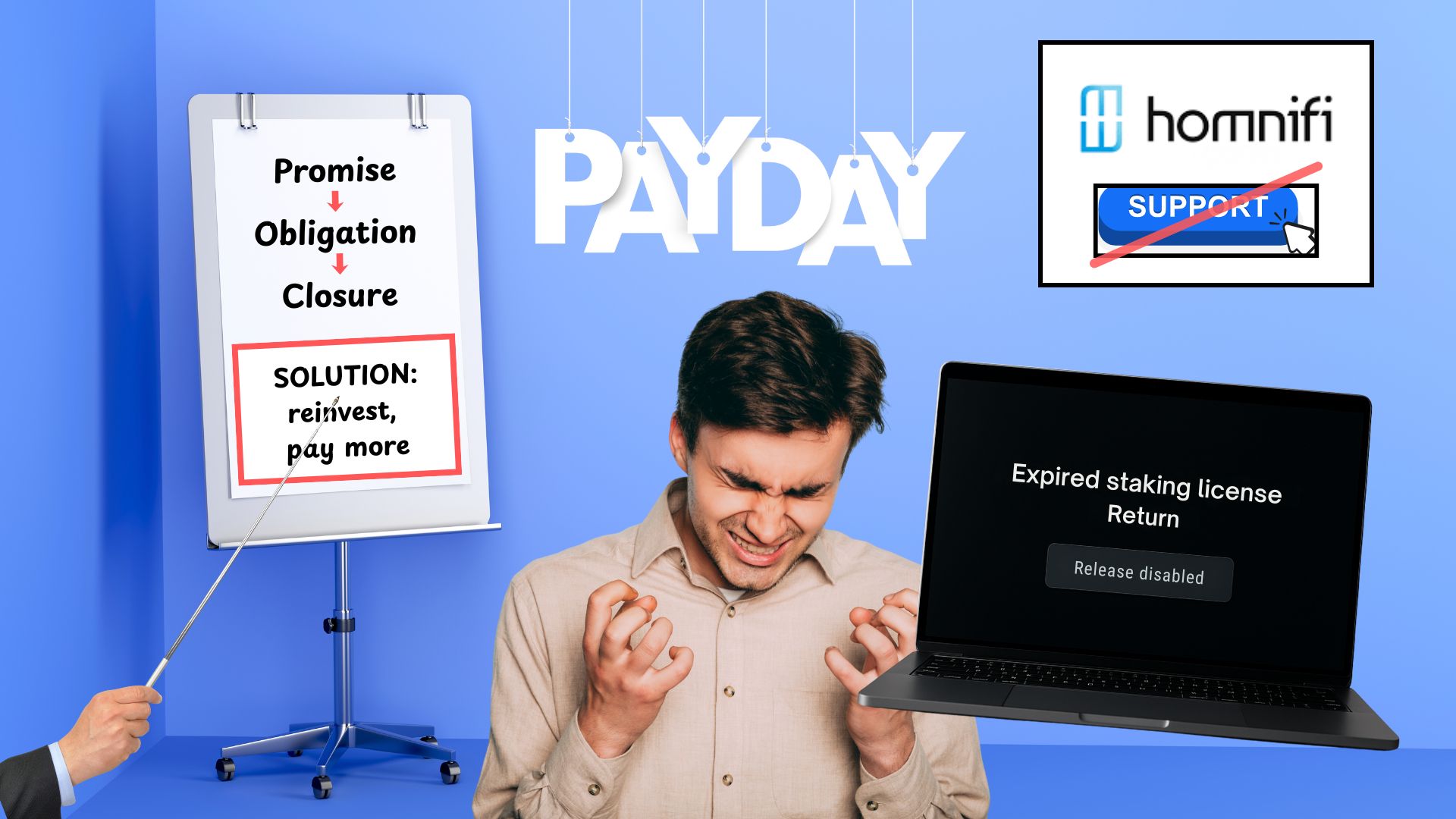
Several users report that when the due date is reached, the release button in their back office appears greyed out. According to them, clicking on it triggers a pop-up window with the message:
‘Release is currently disabled. This is being validated as part of the LayerK DAO proposal and will be activated shortly.’

According to archived wiki entries from 8 October 2025, the DAO was only in the proposal phase at that time, with implementation planned for October and officially scheduled for November. At the same time, support messages sent under the name ‘Helen,’ among others, indicate that all members had allegedly voted for a 500-day lock-up period – a statement that, according to several users, was incomprehensible to them, as they claimed that no GLYK tokens were available for voting at that time and the DAO structure was not yet active.
In the support communication, those affected were also repeatedly referred to DAO decisions and wiki reports without being offered any concrete or immediately implementable steps for release. Users also report that the use of recurring generic names (‘Helen,’ ‘Nancy’) in support makes personal clarification difficult.
Release procedures and technical delays
After the respective 12-, 24- or 36-month term had expired, the amounts invested were to become available again according to the advertised DeFi staking model. Some users compare this model to a fixed investment contract: after the agreed period has expired, they expect the amounts invested to be paid out.
In its communications, Homnifi refers to a transition of the platform to a DAO structure and to a vesting model that provides for a 500-day period with an additional 30-day lock-up phase. According to investors, some of the licences in question already expired in September, meaning that the 30-day period should theoretically have ended. Nevertheless, users continue to report that the claim function remains inactive. This raises questions for many of those involved regarding the transparency and actual implementation status of the platform.
In addition, some members report that mandatory pop-ups appear when they log in, requiring them to agree to new terms and conditions, even if they originally signed up under a different brand. From the perspective of those affected, this makes it even more difficult to access back-office functions.
A structural pattern?
Several users, including those who had previously invested in similar crypto MLM platforms, describe a recurring pattern:
- Promise: High returns through minting or staking.
- Commitment: Lock-in periods of 12 to 36 months.
- Platform changes: Rebranding, migrations or technical restarts.
- New offer: Users are encouraged to invest again in order to ‘regain’ previous values.
- Delays: Support refers to technical processes or structures, while from the user’s perspective, payouts are not made.
For many of those affected, this pattern appears structural rather than random, especially as responsibility shifts between different platform names, brands and technical systems.
Conclusion: familiar mechanisms under new names
The descriptions provided by those affected are similar to numerous cases that have been documented since the collapse of the Safir/Zeniq network. In the opinion of many users, the recovery programmes of various platforms focus more on new deposits than on restoring previous assets.
From the user’s point of view, the frequent change of brands and structures makes it difficult to clarify legal responsibilities, while the underlying contractual issues remain. Even though Homnifi appears to be a new player on the outside, many users perceive the models used – staking licences, rebranding, governance references – as a continuation of familiar patterns.
Anyone who has difficulty accessing due staking funds or sees a greyed-out release button should consider having their case reviewed by a legal or expert advisor.
Note:
This article is based on publicly available sources, documented user reports and editorial analysis. It is intended to inform the public and falls under the freedom of the press and freedom of expression in accordance with Art. 5 GG, Art. 10 ECHR and Art. 85 GDPR.
Facts and opinions have been carefully separated and labelled accordingly.
Sources:
- Australian Securities & Investments Commission (ASIC): Investor Alert List – Homnifi, MoneySmart.gov.au (accessed: 14 November 2025)
- Financial Markets Authority (FMA) New Zealand: XPRO-associated providers – includes Homnifi (accessed: 14 November 2025)
- BrokerChooser: Is Homnifi safe or a scam? (accessed: 14 November 2025)
- Trustpilot: Homnifi Reviews (accessed: 14 November 2025)
- Archived LayerK/Homnifi DAO Wiki, Internet Archive/Wayback Machine (accessed: 14 November 2025)

Leave a Reply
Want to join the discussion?Feel free to contribute!