
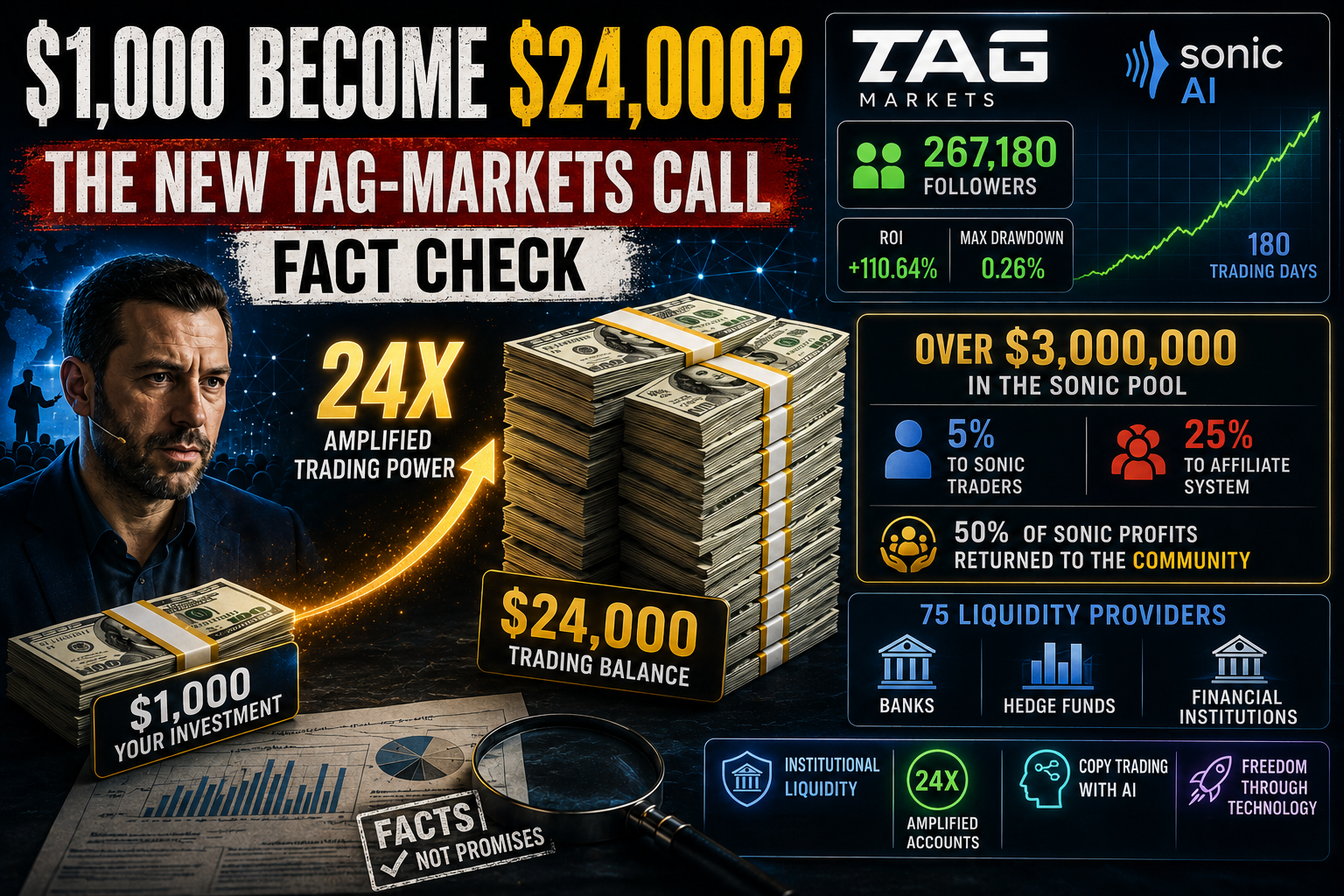
$24.000 out of $1.000 – TAGMarkets Call: More Marketing Than Math?
Nico Krause recently presented new figures for Sonic AI and the “Amplified Accounts” in a new TAGMarkets call—yet behind the spectacular slides, critical questions remain unanswered.
While former top sales representatives from the networks of Lyoness, Lyconet, myWorld, and eCredits continue to heavily promote TAGMarkets, the next chapter of this success story was unveiled in a recent community call. Call host Nicolas Krause, alongside representatives from TAGMarkets and Sonic AI, presented new key performance indicators (KPIs), bonus programs, and once again, the magic formula of “Amplified Accounts.”
The message: more liquidity, more leverage, higher returns—and now, millions of dollars in community pools. However, the closer one looks at the presentation, the more pressing questions arise.
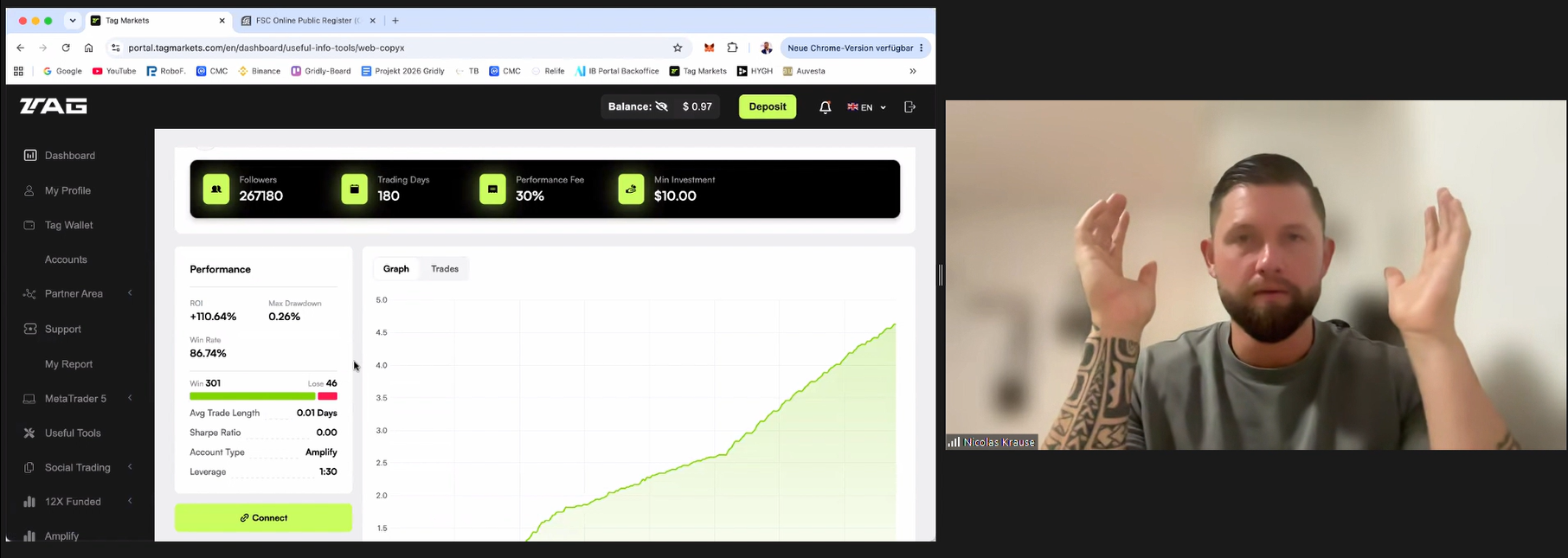
24x Trading Power—or 24x Risk?
The core of the presentation remains the well-known concept of “Amplified Accounts.” The idea sounds spectacular: anyone who deposits $1,000, for example, is supposedly able to trade with a balance of $24,000. A $10,000 deposit turns into $240,000, and $42,000 even becomes more than a million dollars in trading capital. The explanation provided is that this additional capital is supplied by 75 so-called liquidity providers – including banks, hedge funds, and financial institutions. A bold claim indeed.
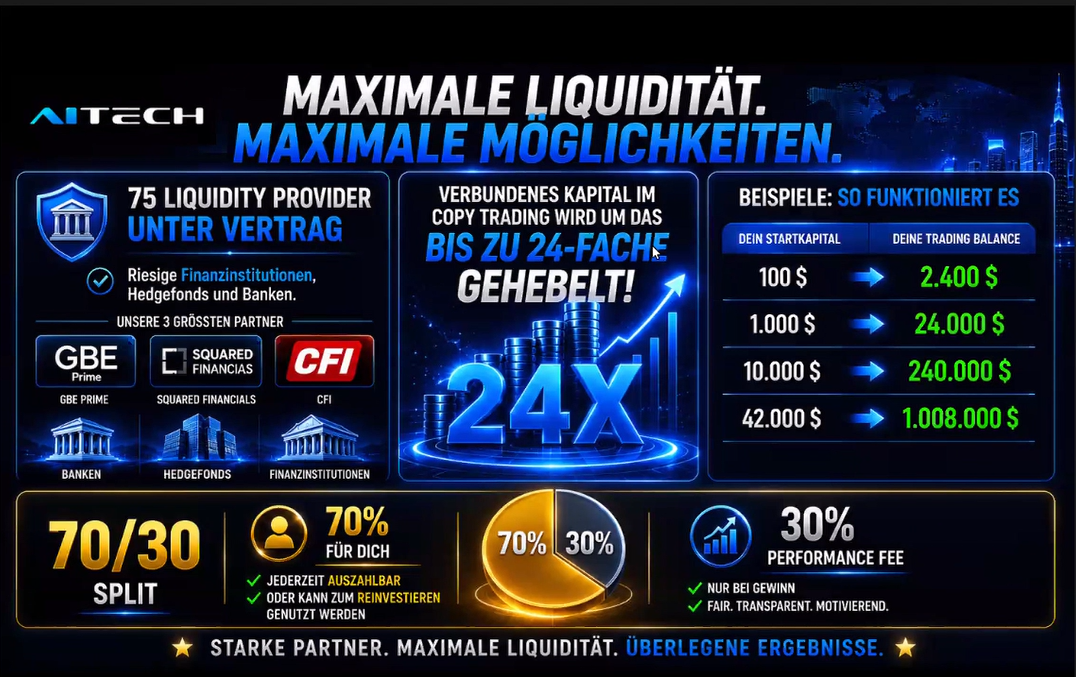
However, it remains unclear how exactly this model works. Who absorbs the default risk? What criteria are used to allocate the capital? What contractual agreements exist between the investor, the broker, and the liquidity providers? And why would institutional capital be made available to retail copy-traders without the standard eligibility tests or risk limits typical of professional prop trading? The presentation leaves these questions unanswered.
70/30? Not Quite: Who Actually Earns What?
The presentation explains that 70 percent of the generated performance profits go to the investor. However, the remaining 30 percent is not kept entirely by the trader. According to information shared during the call, 5 percent goes to the respective Sonic trader, while 25 percent flows into an affiliate or community compensation system. This creates a remarkable distribution: by far the larger share of the performance fee is apparently not used to reward the actual trading performance, but rather to fund the sales and community structure.
From a business economics perspective, this raises questions. If a quarter of all performance fees is reserved for an affiliate system, it begs the question of what role network marketing truly plays within this business model. Traditional copy-trading platforms primarily compensate the traders whose strategies are being copied. Here, however, a significant portion of the returns seems to be utilized to finance a referral or community system.
Whether this model is sustainable in the long run ultimately depends on whether trading profits are consistently high enough to service both the investors and the various compensation levels. This is precisely why a closer look at the economic foundations of the model is warranted. The more complex a compensation system becomes, the more vital the question becomes: where is the value actually generated—through successful trading, or through the continuous influx of new participants and trading volumes?
The New Sonic Pool Bonus
Also newly introduced in this TAGMarkets call was the Sonic Special Pool Bonus. According to the presentation, over three million US dollars are already in this pool. Participants receive so-called “shares,” the number of which is determined by the “Connected Volume.” At the same time, it is claimed that 50 percent of the Sonic profits flow back to the community.
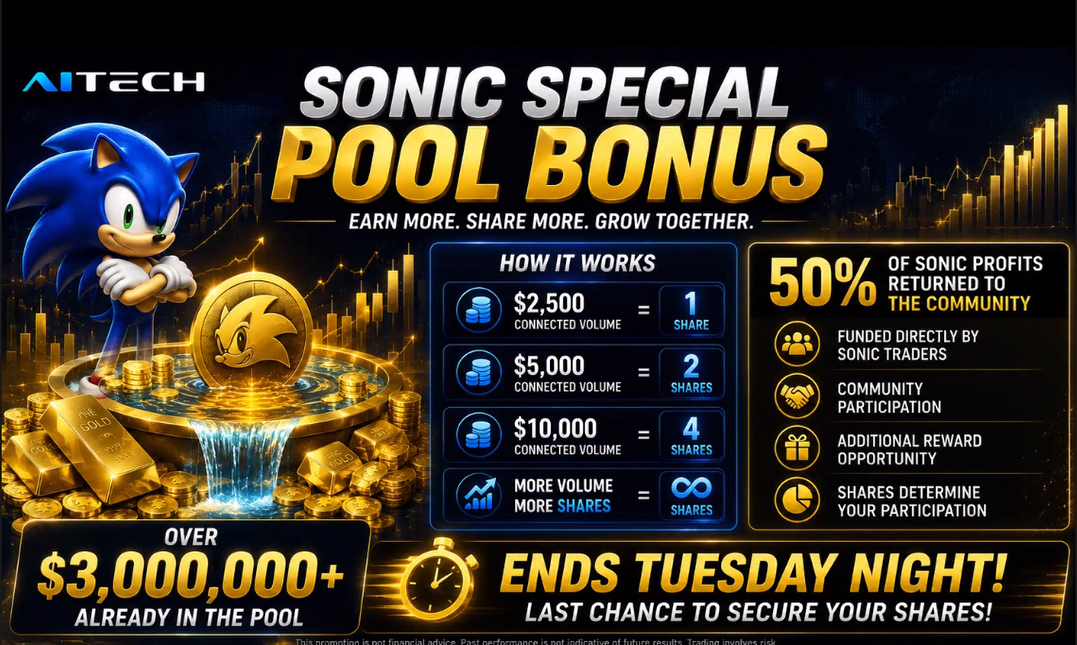
What initially sounds like an attractive profit-sharing scheme raises numerous questions upon closer inspection. What exactly is the “Sonic Pool”? Who manages the funds? How is the term “Sonic Profits” defined? And what does “Connected Volume” mean in concrete terms? These central concepts also remain largely undefined in the presentation. Furthermore, the heavy emphasis on community growth and bonus shares is notable. The higher the generated volume, the more shares participants are supposed to receive. As a result, building structures is increasingly becoming the focal point of the communication.
Conclusion on the TAGMarkets Call: More Marketing Than Mathematics?
The recent presentations follow a distinct pattern. First, impressive figures are showcased. Then, these metrics are paired with buzzwords like “Community,” “AI,” “Freedom,” “Growth,” and “Liquidity.” The effect is obvious: it creates the impression of an exceptionally successful, technologically advanced financial ecosystem. Yet, especially when it comes to extraordinary claims, a simple principle applies: Extraordinary claims require extraordinary evidence.
Copy trading, algorithmic trading strategies, and institutional liquidity providers are nothing unusual in themselves. However, it becomes unusual when extraordinary returns, minimal risks, million-dollar bonus pools, and 24x amplified trading accounts all come together in a single presentation—without the core mechanisms being transparently explained or independently verified.
For investors, one primary question therefore remains open: is the model’s success based on demonstrably superior trading strategies—or primarily on presentations designed to build trust with ever-larger numbers?
Hinweis:
Dieser Beitrag basiert auf öffentlich zugänglichen Quellen, dokumentierten Nutzerberichten und redaktioneller Analyse. Er dient der Information der Öffentlichkeit und fällt unter die Presse- und Meinungsfreiheit gemäß Art. 5 GG, Art. 10 EMRK und Art. 85 DSGVO. Tatsachen und Bewertungen wurden sorgfältig getrennt und entsprechend gekennzeichnet.
Quellen
- Öffentliche Profile der genannten Projekte (u.a. Youtube, Facebook, Telegram-Kanäle), Stand der Recherche: Juni 2026
- Eigene redaktionelle Auswertung von Webinaren, Marketingmaterialien und Anlegerberichten.

Leave a Reply
Want to join the discussion?Feel free to contribute!