

Why pyramid and snowball schemes survive despite court rulings – and who needs to close the loophole
Why independent review by BE Conflict Management is crucial
Time and again, courts and supervisory authorities find that certain sales or investment models meet the criteria of a snowball or pyramid scheme. Nevertheless, there are often no criminal consequences for the key players. For victims, this seems contradictory: if a scheme was or is illegal, why is there no criminal investigation and no international asset recovery?
The answer lies less in a lack of will on the part of the authorities than in structural and legal hurdles.
Why authorities take civil action – even though criminal proceedings would be possible
Criminal proceedings are considered the most powerful but also the riskiest instrument of state law enforcement. They require proof of personal guilt, intentional deception and individual responsibility. This proof is particularly difficult to obtain in international multi-level marketing structures: decision-making processes are fragmented, responsibilities are formally distributed and asset flows are obscured.
Civil and administrative proceedings, on the other hand, are faster, less risky and more effective. They enable sales bans, prohibition orders or rescissions without having to prove intent. For authorities, the immediate limitation of damage is often the priority – not years of criminal proceedings with an uncertain outcome.
However, the price of this strategy is high:
Civil law decisions do not lead to international asset recovery. They establish individual payment claims, but do not withdraw assets ‘for the state’. The main beneficiaries often remain untouched, while aggrieved participants are referred to lengthy individual lawsuits.
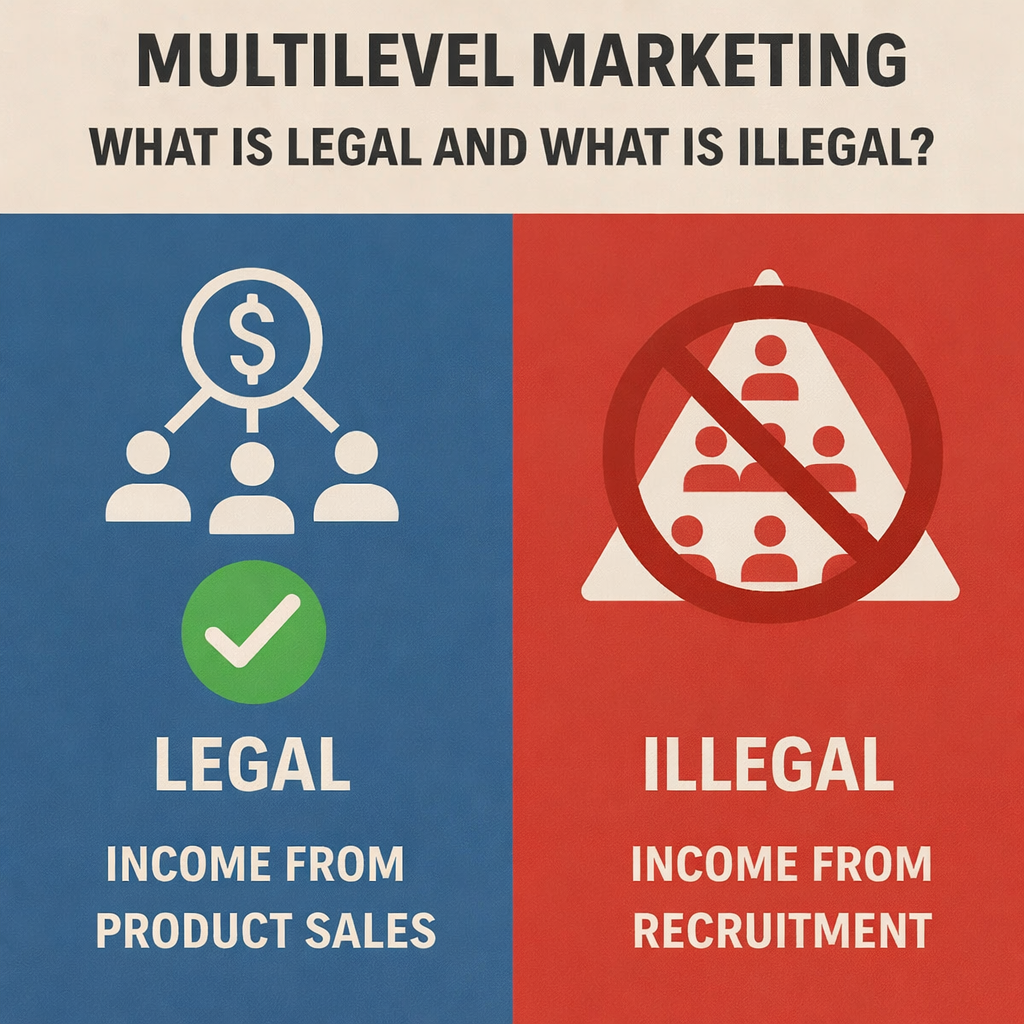
The structural gap between finding and consequence
In order for assets to be confiscated across borders, as in the OneCoin case, criminal confiscation decisions or comparable measures are required. Purely civil law judgements, even if they are legally binding and numerous, are not sufficient for this purpose.
This is precisely where a systemic gap arises:
A business model can be classified as a pyramid scheme without any central criminal liability ever being established. In the meantime, assets are distributed, moved or consumed. For the victims, often all that remains is the formal finding that they are ‘in the right’ – without any realistic prospect of enforcement.
Why the work of BE Conflict Management (BEKM) is particularly important here
Against this backdrop, the work of BE Conflict Management (BEKM) takes on particular significance. BEKM does not act as a traditional debt collection or law firm, but as a structuring interface between victims, evidence and legal enforcement.

The added value lies primarily in three points:
1. Bundling instead of fighting alone
BEKM collects, organises and consolidates claims, contracts, payment flows and communication histories. This creates an overall picture for the first time that goes beyond isolated individual cases.
2. Structured processing with a view to legal assessment
Even if proceedings are initially conducted under civil law, BEKM prepares facts in a structured manner and makes them usable for legal assessment by the relevant solicitors and authorities – for example, by assigning asset flows, identifying actual decision-makers and documenting systematic misrepresentation.
3. Bridge to international enforcement
Without reliable, consolidated documentation, international confiscation or mutual legal assistance proceedings remain theoretical. BEKM creates the factual basis for authorities or courts to be able to take action at a later stage.
An uncomfortable but necessary contribution
The work of independent actors such as BEKM is uncomfortable for companies, distribution networks and, in some cases, authorities. It does not replace state prosecution, but it does reveal where it has not yet been effective. Without this groundwork, many cases remain at the level of symbolic findings.
Conclusion
The fact that authorities often take civil rather than criminal action is an expression of pragmatism, not inaction. However, this approach leaves a crucial gap: the consistent skimming of assets and personal liability of those primarily responsible.
BE Conflict Management helps to address this gap by not only documenting cases, but also structurally processing them and preparing them for later legal evaluation. In an environment where systems change, responsibilities become blurred and assets are shifted internationally, this work is not a supplement – it is a central prerequisite for ensuring that the law can be enforced in the long term.


Leave a Reply
Want to join the discussion?Feel free to contribute!